Episode Transcript
[00:00:00] Speaker A: Foreign.
[00:00:06] Speaker B: Welcome to Gaiman Going Deeper, a podcast by the Gay Men's brotherhood that showcases raw and real conversations about personal development, mental health and sexuality from an unapologetically gay perspective.
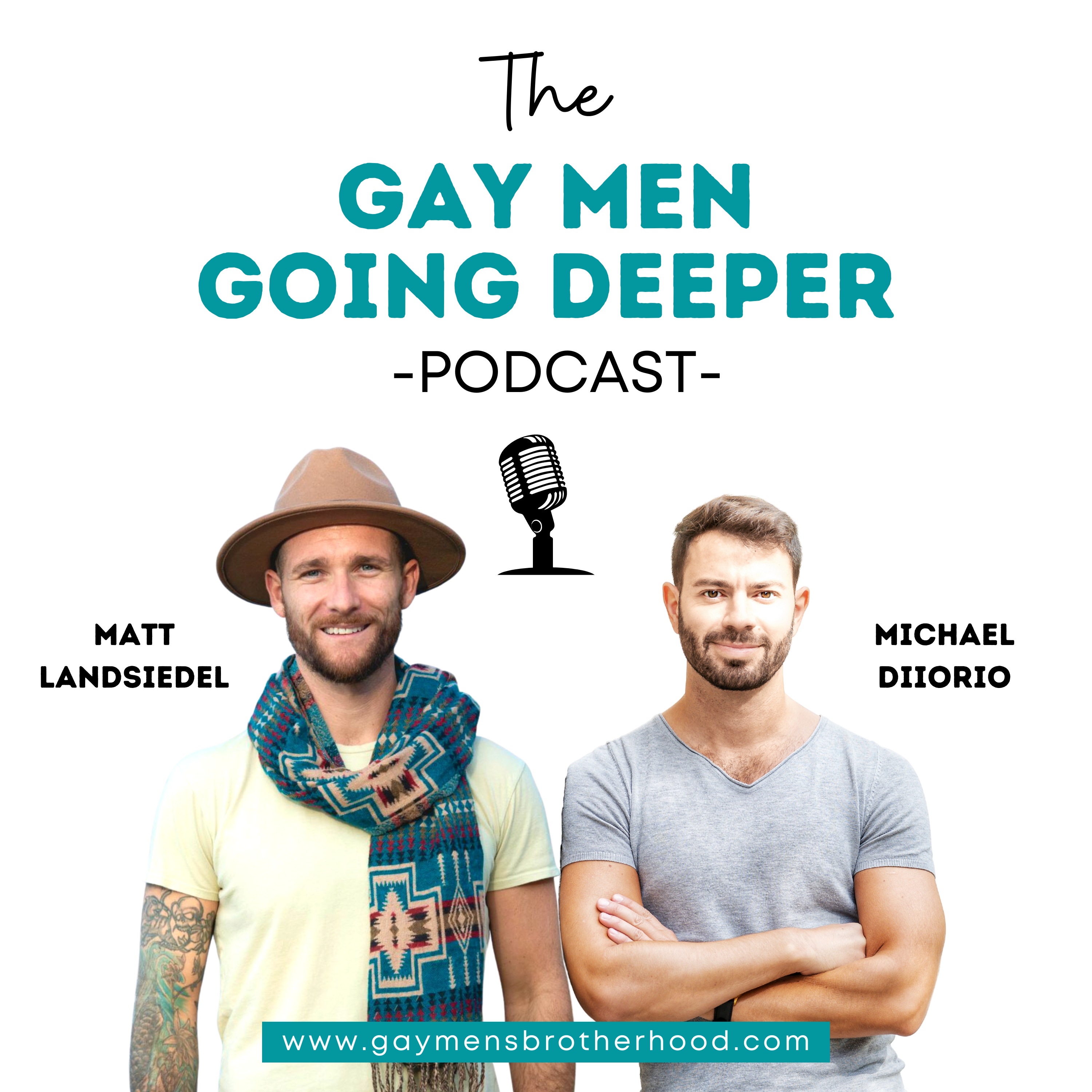
I am your host, Matt Lansdell, and joining me today is my lovely co host, Michael DiIorio. Today we're talking about how to thrive in the culture of body perfection.
This is a big problem in the gay community, so we're going to be unpacking it. We're going to be talking all about how we have learned to thrive in a culture that is telling us to be perfect in our bodies. So we've got a few questions that we're going to be unpacking. How does the culture of body perfection impact you?
How do you participate in body perfection culture, and what have you done to mitigate the impact of body perfection culture?
And what we want you to get out of today's episode is just a deeper understanding of the impacts body perfection and gay culture has on the relationship that you have with your own body and even the relationship that you have with other people's bodies. Okay. Which is going to be an extension of the relationship you have with your own body. Subscribe. If you're new here, please subscribe to the channel on YouTube. And if you're listening on your favorite podcast platform, please subscribe and leave us a review which helps us get into the ears of the people who need us.
This podcast and YouTube channel are listener and viewer supported. If you enjoy what we're creating, you can support the community by making a donation to the show, using the link in the show notes, or tapping the thanks button on YouTube. You can also subscribe to the early access option on Apple and gain early access to our episodes. All your support helps us to continue making content for you and supporting our community. And we do thank you for that in advance. All right, I've got four questions that I want you to think about. The audience and you, Michael. Yeah.
And if you answer yes to these questions, then I want you to keep listening to this episode.
All right, the first question is, do you equate being desirable with being muscular, lean or youthful? Second question, is your self esteem tied to how you look or how others perceive your body? Third question, does scrolling through Instagram feeds of attractive men affect your mood or your self image? And the last question is, do you want to learn how to thrive as a gay man who deeply loves his body regardless of how it looks? So that's what we're. We're here. We're here to have this conversation to help guide you along this journey of learning how to love your body more. The word thrive and the title is very intentional because we want to teach you guys the things that we've learned over the course of the last six years and in doing this work and moving away from external validation and attachment to body perfection and body image, and learn how to be more in our bodies and, and to love our bodies. So I'm definitely not saying we're perfect by any means. We're going to be sharing some of our current hang ups and stuff as well. But let's get this conversation happening. I think it's an important one. So as we know as gay men, body perfection is definitely a way that we use to regulate things like shame, the feelings that come up around rejection, and even more specifically, not feeling man enough. I think if you think about a lot of the internalized homophobia we experience as gay men is actually masked as femme phobia, being afraid of being seen as feminine or weak or sensitive. So a lot of us might try to get into more muscular bodies or look a certain way. So we don't, we can, you know, regulate these, these feelings of inadequacy or shame and whatnot. So that's definitely one of the areas. Okay.
But in our culture, it's also a currency. The body is a currency. It gets us attention, validation, belonging, acceptance, social mobility, these sorts of things. It's really, it's really important to note that because you have to move away from this mentality if you're wanting to heal the relationship with the body, not always using it or constantly using it as a currency.
And then there's also a historical trauma or a collective trauma piece to this. I would, I think after decades of shame, invisibility, things like the AIDS crisis, body perfection or having the perfect body for gay men became a symbol of things like survival, control, pride, social acceptance, these sorts of things. So it's almost like, you know, we've, we don't feel good enough, we feel inadequate, we've been oppressed and marginalized. So we're gonna look good, right? We're gonna be very successful, right? This is a very image, society has this image of gay men, right? That we look a certain way, we're, we're hot, we are successful, these sorts of things. And that can, it can be, you know, a good thing. It gives us, it gives us clout in a sense in society, but it also pulls us further and further away from our authenticity and in some cases each other.
[00:05:03] Speaker A: Right.
[00:05:04] Speaker B: Because it can become A very competitive cutthroat culture when we're competing around things that, you know, in my opinion, can be so superficial. So, and then I just found this quote. In doing some research for this stuff, I found this quote. And it's not, I don't know who it's from, it's just an unknown quote. It says, in a world that tells us we must be flawless to be loved, the most radical act a gay man can do is show up imperfect, embodied, and fully himself.
And I love that.
Right?
So we want to transmit this energy to you guys that it's okay to be imperfect. It's okay to be embodied. Right? Not just look in the mirror at your body, that to actually be in your body and feel what it's like to be in your body and to just be fully you. Right. Regardless of your size or shape, just be full of yourself. So. All right, now I want to hear from you, Michael. I'm curious. How does the culture of body perfection impact you?
[00:05:55] Speaker A: Doesn't.
[00:05:55] Speaker B: How has it? You could answer it either way.
[00:05:58] Speaker A: Yeah, well, it does. It does. Still to this day, like, when you were asking those questions, you know, I was like, yeah, but there's a but, there's a yes, yes, yes, and. Which we'll talk about a bit later. But yeah, it still does to this day. And, and as much as we are aware of all this stuff talking, but we're not immune to it, or at least I, I'm not immune to it.
[00:06:14] Speaker B: Yeah, same here.
[00:06:15] Speaker A: Yeah. So, I mean, looking at my life, I, the spaces I participate in as a gay man, absolutely have all this. And we, I see it, I have a front row seat. So, you know, you guys know that I'm a gym goer. I go to the gym. I love going to the gym. You know, I go to gay events and gay spaces and parties. I go to all the gay destinations. I love all that. That's, that's very much my thing. And even in my, like, Instagram chats and my group chats, my friends are always sending like, these hot guys and those hot guys. And so, you know, like, I, I see it all the time. I'm in it, so the comparing is inevitable because I can't, at least for me, I, I can't turn it off before it happens. I can see it when I'm doing it and then do something about it. But it's, it's, it's just naturally going to be there. But there's a difference between caring for your body, I've learned, and this is Kind of the lesson and then obsessing over it. And that's a line that I.
It's very blurry. I can cross it very easily, and. And I do.
But when I think about it, for me, I think this is true for a lot of folks that I talk to.
It's. It's. It's not really about the body, the aesthetic. I mean, it is, but it's really just the surface. Because when I ask why. Why do we get so obsessive and why does this matter so much? It really boils down to, like, the same things.
We want to be seen, chosen, want the attention.
Ultimately, we're just talking about love and belonging is what we're saying in acceptance. That's it. That's what I want. So, yes, we're like. We think that we need to get that. That sense of love, belonging, and acceptance through this body. We have to look a certain way in order to achieve this. This sense of belonging. So it goes deeper, I think, than just the aesthetic or using that. That aesthetic as a way to achieve that. Because, of course, we think, you know, the assumption is these Hawkeyes must have all the friends, must have all the sex, must have all the boyfriends, must be so easy for them, must be so easy for them. They must have all that connection and belonging. They don't have to suffer. But my friends, I can promise you that's. That's not true.
But I just think that that's how I've come to recognize it. And I can give myself a little bit of grace when I find myself going into that and participating in it a bit is like, this is just my brain trying to convince me that I need to look a certain way in order to have this sense of worthiness.
But as far as. I mean, I don't know about you, but that automatic belief is still there. And then what it does is, is it used to teach me that I, first of all, my worthiness was attached to how I looked, which is not true. And then it got to a point where my body was. I didn't have a good relationship with it. Like, it was this thing that was always needed to be better and never good enough. And instead of this. This home that I live in that is beautiful and wonderful and serves me and is wonderful and, like, it's healthy and wonderful and great, it became this thing that I didn't. That was never good enough. And so that's. That's been my transition.
[00:09:05] Speaker B: Yeah.
[00:09:06] Speaker A: Yeah.
[00:09:07] Speaker B: Is there something that you did specifically to help you move through.
Through that Pressure that you were constantly putting on your body.
[00:09:14] Speaker A: I think for me, it was Covid.
When Covet happened in, In Ontario, we were locked down for ever. We couldn't go to the gym at all. So I literally had no choice. And I, I was not interested in like, I was interested in doing like homework codes. I just, it wasn't my thing. And so I just had no choice but to like, deal with what happens to my body when I don't go to the gym regularly.
[00:09:36] Speaker B: Wasn't.
[00:09:37] Speaker A: It wasn't. It wasn't what I would call pretty by those standards by, in those days, but it really forced me to see, like, oh, wow. Like, this is something that really affects me. Like, I'm really affected. Like, I'm, I'm. It's showing, it's. It's changing the way I show up in the world. So that was actually the. Where things cracked open for me and I was like, okay, I really got. I gotta really. I really gotta change my relationship with my body.
[00:09:58] Speaker B: Yeah, yeah, yeah. It's interesting because I. Around that same time, Covid. It wasn't because of COVID though. I.
I used to do a lot of fitness stuff and I did fitness competitions, men's physique show. And I had a really unhealthy relationship with my body. I was using it for, for currency 100.
And I actually had like an epiphany when I was on stage. The very, the last show that I did, I was on stage and I was like, I literally had a spiritual awakening on the stage. I'm not even kidding. Like, I was. It was like an out of body, outer body experience. And I'm up there like, flexing, but I was like watching these judges judge me and they were like writing down stuff about my body and I just had this moment where I was like, this is so stupid. All of this is just so dumb. You know what I mean? And like, I've worked so hard. I've tortured the out of my body to. For what?
For what? So people can look at me and say, wow, you look so good, or whatever it might be. And it wasn't even about me at that time. It was about, you know, everyone else had the power over how I felt about myself because they needed to see me in order for me to feel good or I needed to see myself in a mirror in order for me to feel good. I was so detached from my own body that it was all just a visual, right? And like an image in my mind. That's what it was like my relationship to my body was an image in my mind just crazy to think about, right. And now that I've, you know, six years later, I've done this massive transformation and part, part and parcel, I was forced into it because I had so many injuries in my body from, from excessively training for almost 18 years and I had have a bulge disc in my neck that's still acting up. So I can't actually go back to the gym and, and train the way that I used to. So my body's changed over six years. It's become a lot more supple, softer.
But the, the love I have for my body and how I feel in my body is completely different. And I would not trade that for anything truly. Like it's a, it's a very different experience to actually be in your body, not to be of your body like in your mind, right. That's like being of your body because it's, you're a separate from it. You're looking at it as if it's almost not you.
[00:12:10] Speaker A: Right.
[00:12:10] Speaker B: But being in my body, it feels like I can feel the feeling of sexy, right. It's not coming from a mirror or a picture or people telling me it's coming from in me. It's an energy of sexiness that I can feel.
So, and then that's not to say like that I've made this total overhaul and I'm. I'm now. Right. Because there's still parts of me that when I go out or I see really attractive guys that have ripped bodies, I'm just like, I kind of wish that my body still looked like that or. Right. So I can get into that mentality of comparing. And I think for me that is how the body perfection culture impacts me. It, it's because it's rampant in our culture. You can't get away from it. And when I see it, it makes me. It activates inadequate parts within me. I think that's what it does. Like the parts inside of me, the egoic parts that are like, you're not good enough. You need to look more this in order to be desirable than right. So.
But it's interesting too because before when I was really muscular and these sorts of things, I was attracting more like feminine, kind of softer, leaner guys. Right. Because they saw me as like whatever alpha top kind of energy and that's not really who I am. And now that I'm more in a bit of a softer feel in my body, I'm attracting the guys that I actually want to be with sexually at Least and physically. So it's just kind of interesting how I was actually, I was. I was doing all this work which was going against me attracting the things that I authentically desire.
So it's all. It's all fascinating. This is such a loaded topic.
[00:13:42] Speaker A: Yeah, it really is. And I don't know about you, but I'm not even. I genuinely am not even attracted to that typical, like, most muscular. Like, I told you, my friends share all these guys on Instagram, and I'm like, guys, this does nothing for me. Like, it really doesn't. Like, I'm not even lying. Like, no, no. Like, everyone thinks these people attractive. And like, no, I don't. And surely there are others who would agree. But it's funny what we think, what we think we need to look like just because of what we see in the world. And maybe on social media and porn, perhaps. But it's interesting to ask yourself that question, like, what do you think you need to look like in order to have that desirability or worthiness? And most of the time, when you ask people, like, hey, what kinds of things are you attracted to physically?
No one. Very few people actually say to me, abs. They actually say, no, I like a guy that's got a little bit of a. That bod. That's what most people say. Yeah, like someone I can cuddle with and they're nice and soft or whatever. Someone's got a little bit of hair on them. I don't. They don't want that smooth, smooth, polished physique. So it's interesting to see what we think we need to look like versus what we. What people actually want out there.
[00:14:49] Speaker B: It's.
[00:14:49] Speaker A: I think. I think it's very different.
[00:14:51] Speaker B: Yeah, I agree. And I have evidence of that because I was at a peak physical condition and now I'm not. And I find that when I was in peak physical condition, guys were threatened by my body.
[00:15:04] Speaker A: Right.
[00:15:04] Speaker B: Because they being naked with me and not feeling good enough, it activated all of their inadequacies. Right. So I find that it was.
Yeah, I'm attracting completely different now and more abundantly now than when I had, like, a super nice body. So I just wanted to. To point that out. And I agree. Like, that's what makes this world go round, is everybody has a different palette for what is attractive. And I think society or mainstream culture just drives this one image forward. But when you actually. If you were to take a poll in Brotherhood, we got 10,000 guys in there. If you were to take a poll and say, what do you find attractive. You're going to get all different things on the spectrum. You're going to get twinks, bears, wolves and otters and whatever all the animals are, right. You're going to get them all. They're all going to be in there. And I think, you know, even masculine, feminine. So we all have different, a different template of what we find attractive. And I think we have to remember that when we're relating to our own body and not just coming at it from I'm not this one thing that I perceive everyone desires because it's not that case.
[00:16:06] Speaker A: Exactly. Yeah.
[00:16:08] Speaker B: All right, this is just getting juicy, folks.
Yeah, let's, let's bring some of that juice into the comments of YouTube. If you're watching on YouTube, drop in the comments. Your answer to this question, how does the culture of body perfection impact you?
How do you see it showing up in, in your life, in with your relationship to your body? And we're going to continue these, these conversations in our connection circles this month. So come and share your voice. We will be breaking off into, we'll start in one large group, we'll unpack the topic a little bit and then we move into smaller pods and you'll have a chance to, to unpack this topic with three or four other other guys that listen to the podcast and go to Gaiman's Brotherhood.com check out the event section to RSVP to this. And if you don't have Facebook, get on our email list and we will email you information about that as well. All right, let's look at how we have or currently still do participate in the body perfection culture.
[00:17:01] Speaker A: Well, I mean, in addition to just said earlier about, you know, finding myself in the comparing everything we just said, I think that it still shows up for me. And like, I, I sure as hell you won't see me posting a photo of me on Instagram where I'm bloated, where I have like now like I, I, I, I'm in Italy by the way, and I've been eating pasta and pizza for like the last month and wine and pastries. Gym is not much a thing for me here. So you won't see me posting any like, sexy selfies on my Insta these days. So in that way I think I, I still, I'm far more likely to post something where I'm shirtless or half naked when I'm, you know, in, in my mind, okay, this is, this is the version of my body I would like to put out into the world. Whereas I think if I did a better job of that. And I think we should all do this, myself included, is to normalize what your body looks like when it's not at peak performance, when it's not fresh from a pump. When I have been in Italy for a month and eating pastries and. And pasta and pizza every day. So that's. That's the way it shows up for me in. In the most obvious way. I still have a lot of hesitation to post that.
[00:18:07] Speaker B: So I stopped in photos. I stopped sucking my gut in and trying to flex my abs. I just went through a period where I just stopped caring. And I had gained a bit of weight. My body was looking softer, My chest was smaller, and my gut was a bit bigger. And I remember I had posted this photo. I think this was last summer or two summers ago.
One of my friends, slash, guy that was in one of my programs messaged me. He's like, I just want to thank you so much for, like, posting that photo. Like, it's vulnerable of you to do that. And I was, like, mortified. I'm like, what do you mean?
What did I do? So I go back and I look and I'm like. Because he was like, yeah, like, your body doesn't look, like, ripped, and you're. I was sitting in a chair, and my gut was, like, kind of, like, hanging over my shorts a little bit. And, yeah, it was just a moment for me. Like, I kind of felt, like, shame come over me. Like, oh, my God. Like, right. People are really critical of my body. And I didn't. I didn't realize this, but it.
You know, and then there was another incident where I had posted a photo, and I think we. Last body episode we did, I ended up. I was emotional. Maybe that was even the first episode we did on Body Image with Callan and Reno. And I got emotional because I saw a picture of myself after, you know, a couple years of not working out, and it was just like something hit. Right? I was just, like, I was grieving the loss of my attachment to my body for my worth. And I was trying so desperately to find worth within myself that didn't come from my body. And so there's a grief. I really want to highlight this. There's a grief that we have to go through in order to let go of some of this shit. Because if we've been holding on to body perfection as an illusion of. Of worse, when we start to let go of it, we're letting go of a piece of our identity or a piece of something that's giving us esteem, confidence, right? And then we're left with what? Right? I was left with like, shit, who am I? Like, what do I actually love about my body when it starts to change? So, yeah, I think that your story just made me think of that, like, the pictures. But now I.
I've kind of tried to let go of that. But I'm not going to lie and say that there isn't a part of me that in the back of my mind that's like, well, when I see a picture of myself, well, you could, you know, clean up here, or these could be a little bit perkier or whatever. Like, I can pick myself apart a little bit, but I know I'm doing it and I catch myself and I'm like, you know what, Matt? And then what I'll do is I'll draw that energy back in to my body and just remember, like, how do I feel in my body right now? I feel grounded, I feel strong, and I start to just embody the feeling of what I want to feel as opposed to just trying to grasp for it outside myself in some really. Some sort of illusion. That's really what it is. It's the illusion.
And then, yeah, I wrote down, you know, to answer the question, how do you participate in body perfection culture? And I just wrote down the illusion of self improvement as self love when it's actually driven by shame. That was what. That's what I was doing most of my life. And I don't do this anymore. I don't, you know, starve myself or eat, like, only chicken and broccoli, you know, and weigh myself every morning. Like, that's how bad it got for me. And that was all masked under the illusion of self improvement. And it wasn't. That's not self improvement. That's self abuse and shame. Right? And it was. It was driven by. By unworthiness and inadequacy. So. So that was. That's the old me. I don't think I do that anymore. But current participation, I would say, is still comparison. It's the biggest one for me. Comparing and. And yeah, I think I'm just looking at my little list here. The other ones I don't do, but I wrote them down because other people might be doing them. And I want. I want people to be aware of them. But liking thirst traps and just giving all the guys that are just posting only their abs and their whole Instagram profile is just them posting selfies of them with their shirts off. And then you have their little. Their audience in Their, in their comments and DMs, and it's just like you're just showering these people with admiration for thirst traps. And what you're doing to that person is actually you're reinforcing their illusion and the, and the shame. And they're, they're right because those people are probably not actually doing the deep work to love themselves because they're finding it from you, the person who's liking their thirst traps.
[00:22:07] Speaker A: Right.
[00:22:07] Speaker B: So that's some. A way that we can be, that we can be participating in it. And then what about the other people that are, are good quality humans but maybe don't look like that. Like where's the love for those people? You know what I mean? So I feel like it's, you know, spreading the love can be a good, a good way. I can tell you want to say something. What do you want to say?
[00:22:25] Speaker A: Two things. I'm trying to keep them in my brain. I love that you can read my mind. I'm like, okay, I have so many things I want to say. One, we'll start with that one. But yes, yes, everything you said and what I've done is actually now the opposite where I won't. Well, first of all, I don't really follow those, those kinds of accounts anyway. But yeah, like when my friends send those things, I'm like, eh, whatever. Like I'll say like I'll purposefully go the opposite way.
Literally nothing for me.
Which is true.
And then the other thing is when people do post things that are more authentic or real or just different. Like you know, I love seeing, I love seeing guys who are like against the mold, against the grain of what we think is hot, post sexy things like in their underwear and a Speedo. And I'm like, yes, like that's what I want to see. And I will purposefully like that.
That's one thing I wanted to say. And then the second thing was I was that guy posting because my, my self worth and my confidence and my, my proof air quotes. Those who can't see me that I was a lovable, desirable man all at that time came from the fact that I had this physique that I liked. It's just, it's just, it's the physique I wanted. It wasn't necessarily muscular, but it's the one that I wanted for me.
And I can tell you guys that when you get all of your self worth and validation from one thing, and that one thing is your body and that body tends to age and be subject to health issues and wrinkles and sags over time. You are in for crisis mode when something happens because you have not. I use the analogy all the time. My clients and group guys know this. The portfolio of self worth. You want a diversified portfolio because if you are overexposed in the body and appearance sector and that goes away for whatever reason, healthcare, aging, you are going to. Yeah, you're going to have a full blown like identity crisis. So it's really important that you get your sense of self worth from all kinds of things. Not. You can be proud of your body, don't get me wrong, that's great. And you can, you can have some identity attached to that. But make sure you also are finding your self worth in your creativity or in your contribution or in your connections or in anything else really. Things that aren't gonna fade away with time.
[00:24:42] Speaker B: Yeah, yeah, so well said. I can see why you were itching to share that.
[00:24:45] Speaker A: Yeah, that's been such a lesson. So we talked about thriving. I think that's been, that's been my number one. If I could give up something that has helped me is just really learn that yes, I can love my body, yes, I can be proud of it and I can still post things, you know, online.
But it's not the only place I'm getting a sense of worth and validation from. I'm getting it from my contributions here. I'm getting it from my friends and family. I'm getting it from myself mainly. That's, that's, that's the number one. So you gotta really diversify those portfolios. Guys. I see this happen all the time with a lot of my clients who do that. And then when they don't get those likes or when they start to dwindle or start to fade away or there's always someone younger and hotter coming up behind them, they do go into like identity crisis mode and they don't know what to do. They don't know who they are because they've spent their whole lives attached to this. I am this hot guy with this body.
[00:25:33] Speaker B: Yeah, yeah, exactly. Such good points. And that's such an eye opener.
So thanks for sharing that. Let us know in the comments. Youtubers, how do you participate in body perfection culture? We want to hear you get honest. Get honest in those. The comment section.
And we have a stream in our coaching collection called Body Positivity. Correct?
[00:25:55] Speaker A: Yes.
[00:25:56] Speaker B: Body Positivity. Yes. So we've got lots of videos in our coaching collection. Our coaching collection is a collection of 45 premium personal development coaching videos in those four streams that we have, Body positivity, community, relationships and confidence. Yes. And then we have our two courses in there as well, Healing your shame and building better relationships. So that's all wrapped up into one coaching package. And it's an evergreen package. You will have it for the rest of your life if you purchase it.
And all those proceeds go to the community to helping us continue to grow this beautiful community. So you can head over to gameandgoingdeeper.com for more information about that. Okay, this is the big Kahuna question. I really want to inspire the audience with this question. So what have you done to mitigate the impact of body perfection culture?
[00:26:42] Speaker A: Well, I think I just told you guys that's probably the number one is starting to really learn to find your sense of worth and validation from other areas. And in doing that, what happens is you stop letting how you look decide your mood. I remember there were days where if I was, I just didn't look at, I'd be so like moody and angry. You know, I don't, I don't have the look I want and it would just totally fuck up my day for. And I get so silly to look at it now. Like, yeah, you're laughing and I'm laughing, but at the time I was very seriously upset about this.
[00:27:11] Speaker B: Oh yeah, like a bad hair day could ruin my day.
[00:27:14] Speaker A: Totally. And I know the people listening like, oh shit, he's talking about me and I'm calling you out. So as I said, Covid was the big wake up call for me.
The. These days when I'm doing like any, any kind of these long travels that you guys know. I do, you know, a month here, two months here, I lose my routine and I, I lose, I lose that kind of what, what I think I want to be at health wise. And so it was actually really good for me and I, I definitely recommend people do that. And you don't need to wait for Covid or like some health crisis or injury to do that, but really start to notice where you're very attached to, to what you look like. Like a bad hair day or, you know, someone takes a picture and they're going to post it and like you panic if it's not the way you want it to look like. And like, no, no, no, you can't post that. Like, oh my gosh, look at me, right? That's a sign that you maybe need to do some, some work there. Another one would be calling myself out and that awareness, like the comparison, like I said, I don't I can't stop the comparison before it happens necessarily all the time.
But when I start to feel that inadequacy and that shame kind of grow within me, luckily I have the awareness to know what that is and what it's from.
And if anyone's listening to this podcast, you probably have the skill to do that as well. To just be like, okay, this is an interesting. This is an interesting story my brain is trying to tell me. And for mine, it's, oh, you know, Michael, you need to look more like this so that you will have a chance at finding love.
[00:28:45] Speaker B: Right?
[00:28:46] Speaker A: That's kind of my story right now. Because I'm single. It's like, oh, well, single. Cause, you know, I've let my. Let my body go or whatever my brain is, so you gotta be really onto yourself. And then finally, with social media, for me, it's curating your feed, making sure, you know, you're not following people just because you like the way they look. I mean, for me, that's just not.
I speak for myself. This is not aligned with what I want to be seeing on my social media. My social media has a lot of. If you see it, my algorithm's a lot of golden girls clips, geography nuggets, because I love geography. And since I'm in Italy now, I'm getting all these reels about Italy, which is so much fun, and food, which is the opposite, and inspirational content. So, you know, really make sure that you are.
We can't control the culture we're in, but we certainly can control the inputs on our devices.
[00:29:29] Speaker B: For sure. For sure.
[00:29:31] Speaker A: And, you know, yeah, I'll leave it there. Those are some of the things that I've done.
[00:29:35] Speaker B: Yeah, yeah, yeah, yeah. I like this idea of, like, you, you know, because, like, I want. I would want to attract somebody that when they see me, they're just like, I like you. I like your energy. And it's not so much about my physical appearance. And it's like, maybe we can be together and grow a little soft together and have some good food and snacks, you know, like, I don't want a relationship that's, like, built around how we look and, you know, posting photos all the time and, like, you know what I mean? So it's all about kind of what I'm wanting. And so, yeah, I just. I was thinking about that and I'm like, somebody's gonna be drawn to you because you're just an awesome guy and you have great energy. It's not going to be about how you look as Much. You know, like, at least that's what I think. The guy that, that you're going to attract is going to be like, he's just going to feel your great energy.
[00:30:19] Speaker A: Or it still will, but he's going to love this.
[00:30:22] Speaker B: All of it.
[00:30:22] Speaker A: Like, all of it. It's like, I don't need. I don't need this version of you. I love the way you are with those extra pounds from the delicious pasta that you've been eating all.
And they're going to love that. And like, I'd rather you know how to make a good pasta than have a six pack, obviously.
[00:30:38] Speaker B: Yeah, yeah, a good point. Okay. What have I done to mitigate? This is. Like I said, this has been my work the last six years because it's. It was such a deep, deep thing for me. And I walked through so much shame and inadequacy to get to where I'm at now. And, you know, I think there's a couple. There's. There's lots of things here, but I'd say the first one I wrote down is take a break from the habits that are driving you into body perfection pressure.
So, like, there's. You can't do this work if you are staying in the. The habits and the constant routines that you have that are perpetuating the body perfection pressure. So scrolling on Instagram and looking at all these hot guys constantly, like, that is changing your brain. It is affecting your brain. It is releasing dopamine around these things. Sure, it's creating arousal, but then if it's creating also inadequacy in your body, not feeling good enough. It's. That's creating a, a neural pathway, right? So you got to take a break from that. So go off of social media for a bit. You know, like, for me, when I did this work and I very first started it, I went to live in Asia for a year, wasn't on social media barely at all. And I took a break from, from working out. I didn't work out at all. I wasn't eating like a maniac. I was having desserts again, like, so I had to, like, change my, my habit. I changed my environment.
I think that creates this, the. The, like a milieu for you to be able to do the work right. So that's probably the biggest one.
And I'm going to be honest, like, something like Grindr is going to keep you in that cycle. It's no different than all the stuff that you're seeing on, on Instagram. It's just bodies, bodies, bodies, bodies. Right? And people being like, ew, or blocking you because you're not good enough. Like, it's just. All it is. All it's doing is just perpetuating the culture of what we're trying to. To help you move away from. So. And then the big kahuna for me, which is a very spiritual thing, which is be in my body rather than constantly judging it.
So letting go of this idea of how I look in my mind, I had to reshape the image, right? We. I think we all have that. We all have this image of who we are in our minds, and sometimes that's. That goes against who we want to become, right? So we can have the who I want to be or who I need to be in order to be hot, which is. We have. We think that we have to be this certain thing. Then we might have the vision of who we are, and we have to actually work on changing that. We have to work on creating more. What's the word? More space for other versions to come in, for other things to be attractive. It's like it's okay for me to be softer. Softer attracts this. I'm more in my feminine. I can be sexy in that feminine energy, right? So it's like opening up and making greater capacity for different things to be perceived as attractive. And then I wrote down viewing the body as a vessel for expression, pleasure and connection, not a project to be perfected. And I think that's just so important for me because my body. What, like, what does my body do if I think about it, right? Like, my body is constantly expressing itself through all sorts of things, right? Burping, farting, crying, yawning. Like, I get to express myself in the way that I talk, with my hands. My face is constantly expressing itself. So our bodies are meant to be just vessels of expression. And through that expression, we get connection. People see us in our. In our aliveness, and they're like, oh, I really like this person. They're drawn to you. So our bodies are attracting connection. And then through that connection, we can get pleasure, right? So not just sexual pleasure. We can get all types of pleasure. Pleasure from food and tasting food and.
And, yeah, sexual pleasure, which is beautiful and amazing.
So I just think it's. It's. There's so much more. There's so much more there, guys. Like, if you're stuck in this trap of body perfection, there's so much more than just trying to treat your body like a project to be perfected. It's like, open up the capacity vessel and Find these other things. And sometimes it, that means, you know, going to therapy or sometimes that means to come to one of our connection circles and talk about it, Talk about your insecurity around your body and talk about not feeling good enough because you're not alone in that and other people are. Would be inspired to hear you share about it. So I just think it's, it's an important thing and that's one of the biggest things. So how did I mitigate that? I. Right around that time when all this started, Like, I'm starting a brotherhood with people who don't just want sex and body perfection and stuff. And we started the brotherhood and we've grown this over the last seven years, which is, you know, we're creating a culture where we can have conversations about the body insecurity, where we can have, you know, break down these, These barriers that we have to our own relationships to our bodies. I think, I think that's really important. So building communities that value authenticity over aesthetics, I think that's kind of what we're doing here, is we're, we're trying to build a culture where authenticity is the top dog, right? Yeah, yeah.
[00:35:29] Speaker A: And like I said about social media, it's just taking that same concept and applying it to your whole life. Like, you don't get to control gay culture and what people do that. You can absolutely control who you, who you.
What spaces you put yourself in, who.
[00:35:43] Speaker B: You expose yourself to.
[00:35:44] Speaker A: And so if you're in a group of people who also share that belief that we have to look this way in order to achieve whatever they're looking for, desirability, love, connection, then it's going to be really easy to fall into them. It's just going to be this echo chamber of the same, same opinions and, and you're not going to, like, unsubscribe and like, check out of the Matrix, which is what I think we need to do. And that's exactly what. What the Gaiman's Brotherhood does and the community, because so many people who just join us say, oh, my gosh, this is so refreshing. People who come to our connection circles will say, oh, my gosh, there's. It's so nice to meet guys like you, gay guys like you, who. Not. I'm not talking about me, I'm talking about guys in the circle who can have deeper conversations, who want to have conversations about these things, who also are okay sharing their insecurities and vulnerabilities. And we still have a good time too, right?
[00:36:34] Speaker B: Yeah, exactly. Yeah. Shout out to all those people that are coming to our.
[00:36:39] Speaker A: Yes.
[00:36:39] Speaker B: Well, just even being in the brotherhood, you know, sharing on in the Facebook group, coming to our connection circles, listening to the podcast and, you know, you're showing up and you're doing this work and you're learning how to love yourself in a deeper, more profound way. I think it's, it's important.
[00:36:53] Speaker A: I want to ask a sub question, if I may.
[00:36:55] Speaker B: Yeah, please.
[00:36:56] Speaker A: On this. So, you know, for. I think for me, the, the hard part is that I choose to still engage in spaces where this is very.
It's like exposure therapy almost. Like I said, I go to the gym, I go to parties, I do all this and I want to. And it's fine. My work has been. I didn't want to not go to that because I actually got a lot from those spaces and I truly, genuinely enjoy them. My work was to like be in these spaces and not. And enjoy it, but not let it completely tear down my self esteem or not let myself get so wrapped up in it. And that's been the hard work. So what advice do you have for people who do enjoy going to the gym or do want to keep going to the gym and be in those spaces and also do everything that we're talking about here?
[00:37:41] Speaker B: I would say take a break first.
If you're stuck in this and you're entrenched, I would say take a break. But then as far as getting back, like moving back into it. Yeah. You got to have an anchor. You got to have a grounding in yourself. Right. And it's just noticing those things that we do that we start to conform to that culture.
A good example is, you know, everyone at the, at the pool party is sucking their abs in and like, do I want to be a guy that the whole two hours I'm there, I'm sucking my abs in because it's exhausting and my abs are hurting and I'm creating unnecessary tension in that area.
[00:38:16] Speaker A: Right.
[00:38:17] Speaker B: So it's like, it's, it's. And part of that is to just maybe stop looking around. Stop looking around at who's looking at you or you know, stop being so outside yourself. Come back in. Come back into your body. Some of the most attractive guys whenever I go out to these things are the guys that aren't looking around at who's looking at them. They're in their essence, they're in their moment and they're just, they're right and they're not sucking their abs in and they're not worried about all this sort of stuff. I think that right there is, like, true confidence. So. But it's hard to do that. It really is hard to do that. Like, you know, and I know for me, I get triggered if I go to. You know, even when we were in PV and we were at the beach and like Myanmar or whatever that place is called, I can't remember, but there's like Mantamar, all the guys were just all ripped. And like, you could. Right. There's just that and there's that culture. But, you know, as an empath, I can feel in these people is that there's not deep love for themselves. It's like they need to be seen, they need to be ripped, they need to be working out constantly in order to feel right. And not saying all of them are like that, but I'm gonna put it out there that there's probably a large handful of those guys that are. They don't have deep love for themselves. Right. They haven't cultivated that, which is why they need to look the part to get the validation. So, you know, with. With.
Yeah, I'll just leave it there, I think. Yeah. Yeah. Well, how would you answer the question?
[00:39:32] Speaker A: Yeah, besides the, The. The diversifying of the portfolio bit like, when it comes to my relationship with the gym, I mean, when I'm at home, I do love going, but it's, It's. I really changed my, My reason why.
And I found other reasons. I mean, don't. Of course, the byproduct, a great byproduct is how good I feel in the pump after. And, you know, that's always there. But it's more than that for me. Like, I really enjoy going to get time with myself.
I join going because that's the time I get to listen to music or listen to a podcast is really just at the gym or my walk to and from. That's pretty much all I have. It's time for myself. I don't. I don't work out with people, as my gym friends know, very much to myself. I'm a lone wolf at the gym. And so there's like lots of reasons why I go that are not just because. Oh my gosh, okay, I need to. To hit whatever look I want to get. It is a lovely byproduct. I'm not going to deny that I don't love that afterwards. But, you know, I had to find other reasons why when it comes to the gay spaces, things like Mantlemire and pv. I told the story before when I was watching the guys take A selfie. You have to laugh, like, you have to laugh, like. Yeah, I think we have to laugh on ourselves. Yeah, yeah. And so when we do it, like, you know, like, I think we can lighten up a little bit about it because we're all doing it. I think people who. Who listen here can be like, yeah, okay, I've done that before. But, like, can we just laugh at it a bit? Like, in just the humanness of it, Just the humanness of, oh, someone's got their camera out. Let's all suck in. Like, it's just so. It is funny. And so part of me laughs. And when I. When I can laugh at it a bit, just kind of takes the seriousness out of it.
Yeah, yeah, yeah.
[00:41:06] Speaker B: But the thing about body perfection is it's contagious.
And when we see someone else being perfect, and I'm using air quotes, it puts pressure on us to feel like we have to be that way or it's like, I can't be. I can't have my belly out because then I'm not going to be whatever, right? So I do think that there's a. There's a rebellion that I want to. I want to inspire in people to be like that. I'm not doing that right, because it's like, no, I don't want. I want people to feel like they can let their gut out around me. I don't want people to feel like they have to suck in when they're around me. Right. So we can create a culture where people can just be themselves. And so that's what I want to inspire.
But I also want it. Don't want it to come from a place of judging people that do that, because I get it. I get where it comes from. I've been there. And I can even still sometimes land in that space. So I have compassion for it 100%. I want something different.
[00:41:56] Speaker A: And it's that story that I had said at the beginning. Ask yourself how much of that is true for you as it is for me. If you ask yourself, why.
Why do I think I need to look this way? And for me, it was about, I want to be seen. I want to be chosen. I want the attention. I want love, I want to belong. I want to be part of it. And that's all it is. It's just this deep need for belonging, connection, whatever you want to call it. And we think we need to achieve it through something on the surface. It doesn't work that way. It'll get you attention, sure. Absolutely. Will get you Attention. Will it get you connection?
No.
Yeah.
[00:42:33] Speaker B: Yeah. So even asking yourself in. In what other ways can I get belonging and love and connection and approval and validation and all the things that we desire? What are other ways that I can get that?
[00:42:45] Speaker A: Right?
[00:42:45] Speaker B: You don't need to turn off the taps to the other one, but let's turn on some other taps and look at, like, what else is currency in gay culture, right? Like, more work we do on ourselves and the deeper we go within ourselves. I think a currency is energy, right? Like beautiful energy and somebody's heart and somebody has an open heart. Like, man, that's some yummy stuff, right? That's more currency. So let's work on opening our hearts, brothers, and finding love that way.
[00:43:10] Speaker A: Amen. Amen.
[00:43:13] Speaker B: Amen. All right, closing comments. Anything from you?
[00:43:16] Speaker A: I think it's been great. Thank you for the conversation today.
[00:43:20] Speaker B: Yes, it has been good. Yes. And thank you to our listeners, viewers for tuning in to yet another episode. Share some comments. Let us know how this, how you're feeling right now after hearing what we've shared. What. How have we impacted you? What are you noticing happening in your body as we've. We've shared?
And again, just reminder that this podcast and YouTube channel are listener and viewer supported. If you enjoy what we're creating, you can support the community by making a donation to the show and the show notes or the link is in the show notes. You can also tap the thanks button on YouTube and we have early access option on Apple Podcast. If you want to gain early access to our episodes, that will also support our community and we do. Thank you in advance and we hope to see you at our connection circles happening this month.
All right, for everything related to the Gay Men's Brotherhood, you can go togay men's brotherhood dot com.
All right, much love, everybody.