Episode Transcript
[00:00:00] Speaker A: Foreign.
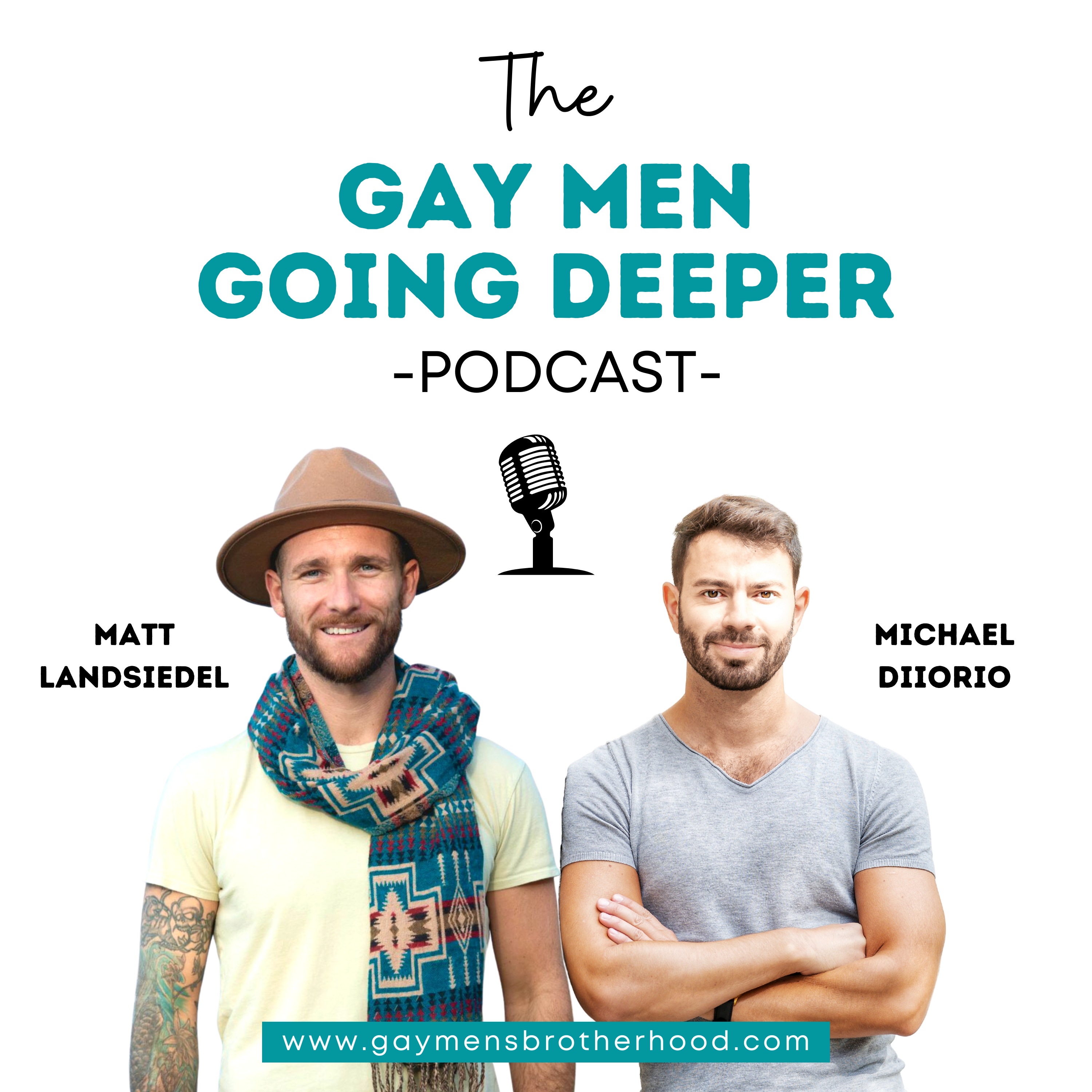
[00:00:07] Speaker B: Welcome to Gay Men Going Deeper, a podcast by the Gaiman's Brotherhood that showcases raw and real conversations about personal development, mental health and sexuality from an unapologetically gay perspective. I'm your host, Matt Lansdell, and joining me today is my lovely co host, Michael Diorio.
[00:00:23] Speaker A: Hi, everyone.
[00:00:24] Speaker B: Welcome.
Okay, today we're talking about why intimacy feels safer in fantasy than in reality for gay men. Okay, so we're talking about avoidance and the fear of being truly seen. This is something that I think all human beings can relate to. But I also think as gay men growing up, we have a lot of possibility of being rejected. So this creates a deep seated fear of intimacy, in my opinion. So, yeah, I chose this topic because there is a part of me, I have a wish. I have a big desire. I've had this for the last seven years since starting the brotherhood, that more and more gay men will develop consciousness and connection to themselves and healing. And there will be a greater capacity for intimacy within our culture.
[00:01:07] Speaker A: Right.
[00:01:07] Speaker B: And under the umbrella of intimacy, I include sex, I include physical intimacy, I include emotional intimacy, all this stuff, right? So, but within this, there has to be an element of being seen. You think about sex, right? You're taking off your clothes, you're letting someone see your body. So I want to, you know, explore what intimacy looks like when we're taking off our masks and, you know, our, our armor and these sor. Things and, and why this is so scary. Even more scary for most people than taking their clothes off in front of another human being. So. And yeah, so Michael and I want to. Want to share a bit about, you know, maybe some of our own experiences of what that feels like to be truly seen and, and whatnot. So one thing I will say is the fear of intimacy is not necessarily just the fear of connection. I think when I, when I say that and I use that term, people are. No, I don't really have a fear of intimacy, right, because they equate intimacy with just connecting with somebody. But the thing with connecting with somebody is there's. There's a lot of opportunity for be painful in connection as well. And like, for example, rejection, judgment, criticism, betrayal, like all the things that can happen in intimacy. And I think that's why a lot of us are afraid of intimacy, because it can hurt us and make us feel very vulnerable. So, yeah, let's just unpack maybe first of all, like, what, what do you think people, what fantasy do you think people have about intimacy? Like, we'll start with that. Like, how do people, how do people fantasize it as opposed to actually understand what intimacy really is?
[00:02:31] Speaker A: Yeah. The fantasy think is like perfection and then there's nothing to risk. Yeah, there's no risk. Like I can just be me and they're going to love me no matter what. And you know, and then the same for them. I'm going to. I'm going to love you and I'm going to love you no matter what, and you're going love me no matter what and there's no risk.
[00:02:53] Speaker B: Yeah.
[00:02:53] Speaker A: The fantasy is that there's nothing on the line. There's no risk of rejection, there's no risk of abandonment, there's no risk of conflict. All these things, as soon as they're. As soon as it becomes real out of the fantasy, that's where the. I think the fear comes in. Like, oh my gosh, I might get rejected. I might get abandoned. He might not like this about me or they might not like this. Or am I not. I might not like him. That's also part of it too.
[00:03:15] Speaker B: Yeah.
[00:03:16] Speaker A: A lot of folks out there is like, what if I hurt him? What if I break his heart? What if I'm. What if I'm so broken that I'm gonna, I'm gonna hurt him right there. I think it works both ways. So I think that's it. I think that the fantasy is that there's no risk in, In a fantasy.
[00:03:29] Speaker B: Yeah, yeah. Like I'm. I'm gonna be selective in what I reveal.
[00:03:34] Speaker A: Yeah.
[00:03:35] Speaker B: Right. And it's like a people pleaser going into intimacy. Right. Like they're going to be selective in how they show up. So they're going to be very premeditated. So that's not really intimacy, folks. That's like, if you have full control over perception, it's not actually intimacy. You're not actually letting go. You're not practicing vulnerability. You're not practicing full transparency and authenticity. So. So yeah, that's. That's kind of the fantasy side. Right. That's where stay safe. Where we're still, we're still guarded. We might idealize the relationship and, and people please that are fond so we. There's no conflict. Right. So it's like the honeymoon phase when you think about it.
[00:04:12] Speaker A: Right as I'm thinking about it more. If you think about the way that we connect these days on apps and online, it's so controlled and curated. Right. And you can. And then if we get addicted to that, you can curate your profile, you can curate your body even. You can curate the texts you send the DMs. You can curate everything so nicely on Grindr, on your dating profile, or on Instagram, even your personality. You can make people believe what you want them to believe. Yeah. But then as soon as that curation goes away and you're dealt and you're dealing with a real life human being minus all that control over you have, over everything you have, that's when people panic. Because now they're not just consuming the image you want them to see of you, they're actually going to experience you in real time. And I think a lot of people are afraid of that.
[00:04:59] Speaker B: Yeah. Yeah. Are you. Do you show up differently behind a screen than you do in person, would you say?
[00:05:04] Speaker A: Yeah, for sure. I mean, I think. I think we all try to put our best foot forward online. But what I will tell people in, like, on a dating app or something, like, one of the things I ask them is, is like, what would your ex warn me about you? And they hate that question. But I think it's such a good one because I know you're not perfect. Like, I know that part of this journey, if we're going to be together, is there's going to be things about you that I find annoying, irritating, that I don't like. Let's just get those out of the way. And I'll be the same thing. They'll be like, oh, wow, you seem so great and you seem like such a great guy. And I'll say, nope, you know, that's very nice, thank you. But I. I'm not just to try to, like, level set. I promise you, I can be very annoying and you will not like me some days. But that's just the reality of it. Let's call it what it is. No one's perfect. So, yeah, I do want to present well, obviously. But as soon as I start sensing people are, like, either putting them on a pedestal or, like, being too charming with me, I'd be like, no, you gotta tone that down. Don't put it on pedestal.
[00:05:56] Speaker B: Yeah, yeah. It's almost like a bit of a, like kind of a yellow flag for me when somebody's just like, pouring the charm on.
[00:06:04] Speaker A: Yes.
[00:06:05] Speaker B: I'm like, that's again, why I love authentic relating. And I love, like, just realness. And, like, I'm so attracted to men that are just like, they're not trying to prove anything to me. And I can tell that, right? You can know, you can feel when somebody's trying to butter you up. And it's like, I just like it when a guy's Just himself. There's no. There's no performance. Right.
[00:06:24] Speaker A: And I want to be. If I'm thinking about dating, I want to be in love with the fullness of someone. Like their. Their awkwardness, their neediness, their insecurity, their contradictions. Like all of those things I like. Tell me not. Not like on the first date, but those are the fun things that I want to. That's what I will fall in love with. I'm not going to fall in love with perfection. I don't think we do. But we have the sense that in order to be lovable, I need to be this, like, robotic, perfect, whatever that means. Version. Body, personality, all the things. And yet what actually makes people lovable, when you think about the people you love the most is the imperfections. How they're. How they're flawed and wonderful. Not saying that they're not good, but it's. It's the balance of both. It's like I think of the people that I've loved in my life and the things that made me fall in love with them or when I see them in those tender moments when they share an insecurity or something. Vulnerable. And everyone loves seeing people. Other people, be vulnerable. Vulnerable. But we don't want to be vulnerable ourselves.
[00:07:20] Speaker B: Yeah. Yeah, I like that. You reminded me of a quote, trying to see if I can remember it. So your imperfect. Your imperfections are what make you humble and your humility is what makes you beautiful.
And I just think it's so true, right? Because. Yeah, I don't. I don't. I'm not attracted to perfection. I like it when a guy has, like, you know, insecurities or these kind of things about themselves. But yet we're the first ones to be so harsh and judge these. These parts of ourselves. And I'm just as guilty of it. Like, I have this idea in mind of how I have to look, right? And it's like over the years, I've. I've loosened that and I've let go of it, but I still hold this idea of I need to be a certain image in order to be attractive. And.
Yeah. And I'm learning to. To be okay with not doing my hair or, you know, not having to have a six pack or all these things, right? It's like, can I just find myself attractive in the energy of who I am? And.
Yeah, intimacy feels a lot safer when I'm not being so hard on myself.
[00:08:19] Speaker A: Right. I find those. Those polished f. Especially when they cling onto it. They definitely won't let that wall down. I find that so boring. And I'm like, whoa, gross.
Like, you're so unattractive to me. Like, you're not interesting. Like, tell me something interesting. Like, I know you have something, but. No, they have to be. No, this is. This is. This is how I want to present. And like, deep down, I know that that's insecurity. But I'm like, I would love to just you to say, you know what? I'm feeling really insecure, and that's making me feel like I need to act this way around you. But actually, I really like you and I'm really scared that you're not like me. And that's why I'm acting this way.
[00:08:49] Speaker B: Yeah. Imagine.
I love that. Like, that's one of the reasons why I love autistic people, because they. They say shit like that. And I'm like, yes. I'm like, this is beautiful. Or just any neurodivergent people I find, they're just. They speak what's there. Right. They don't have. Okay, so this is interesting because I want to normalize that because I think a lot of us are that person, right? We feel like we have to perform or be perfect or say the right thing. So let's. Let's unders. Like, let's normalize that and like, maybe share a bit of the psychology of why. Like, why are. Well, let's actually speak from ourselves. I don't want analyze people like, let's just speak for ourselves. Why. What do you fear about intimacy? What's hard about that for you? And then I'll share as well.
[00:09:26] Speaker A: Yeah, it's what I said. It's.
[00:09:28] Speaker B: It's.
[00:09:28] Speaker A: I want this thing. I want this thing. Let's call it a relationship or I just want to be loved, whatever it looks like. Right. And so I want to put my best self forward.
[00:09:38] Speaker B: Okay.
[00:09:38] Speaker A: And the fear is they're going to see something they don't like and withdraw the love, the attention. And so it's like, I feel like I have to walk on eggshells to portray what I think. And I don't even know what this person wants. I don't know them. I don't know they're looking for, but I think I know what they want. So I'm. I have to like, okay, you know, talk like this, stand like this, wear these clothes, say these things. Don't say these things. Don't say those things. Don't talk about that thing you did.
And it's this. It's this curation going back to that word of how I think I need to be so that the fear is they'll stick around. It's. It's just a stay, please stay and please like me. Please like me. That's it.
[00:10:17] Speaker B: Yeah. What are you afraid of being rejected for? I'm just curious. What's one of them like?
I love Sarah as well, too. I know it's vulnerable to.
[00:10:24] Speaker A: Yeah, I think for me, because I. I'm really out. I put myself out there with how I interact with the gay world. I think a lot of guys are maybe intimidated by that. So if they see someone who's very, like, sex positive and sexual out there, they will create an image of what they think I'm about, and they'll just, like, write me off. And so part of me feels like, oh, I need to be this, like, good boy, whatever that means, so that they see that I am. Actually, there's way more to me than. Than just they might see on something like Instagram or on a dating profile. So I will kind of tone myself down in that way because I'm afraid they're gonna be like, oh, this is just another one of those fucking vapid scene queens. And then off they go. Meanwhile, I'm like, no, bitch. I'm just having some fun with my friends who happen to be gay. But. But people will. Will see what they want to see and make a. Make their assumptions. And so I try to proactively make myself, like, shrink so that they don't have that assumption, but it's not naturally who I am.
[00:11:20] Speaker B: Yeah, I can relate to that. Not in the exact context that you're speaking of it in, but.
Yeah, I think one of the things that I'm afraid of being judged or being rejected for is being too much. I'm intense. Yeah. And I have that same experience. I know that the way that I show up in this world is not for everybody. And I think that I've been rejected for that many times by guys because they're like, well, I don't know what to even do with this. It's too much like. But in the sense that it's like, I viewed my too muchness as like, I'm just. I'm. I'm. I'm living my life. I'm. I'm expressing my emotions. I wear my heart on my sleeve. Like, I. And this is why I've done all this hard work on myself. So the people that I'm being rejected by are people that have not actually embodied this. They haven't embodied authenticity. And the. The Ability to be fully expressive of their emotions and their thoughts. Right. So. But it comes up for me all the time. Right. And being demisexual, I'm like, there's that. That piece that. It's like. It's not even that I'd be rejected for being demisexual. It's that. That. That the guys aren't willing to slow down enough to. To match my pace. Right. Like, they want to go too fast. So, like, my pace isn't enough for them, I think, maybe. Do you know what I mean?
[00:12:28] Speaker A: Like, yeah, I think the slowing down thing, for me, it's not. Not about the pace. It's about they're not willing to slow down enough to actually get to know all of me.
[00:12:38] Speaker B: Yeah.
[00:12:38] Speaker A: And what. In my fantasy, my, like, intimacy fantasy. Intimacy fantasy is someone who knows me to the level I know myself.
And there are so many nuances and layers there, and I'm so willing to open those doors up to somebody. But the fear is they're gonna get into one room and be like, oh, bitch, I don't want to deal with this. I know. And so I'm like, so then I don't do it. I keep parts of me closed, but more than anything, I would just love someone to, like, be inside my heart and my mind and be like, you are such, like, a maze of contradictions, and I love you for it.
[00:13:11] Speaker B: Yeah. Yeah. I can see we both share a similar fear here, because it's probably the Gemini thing, too.
We have two people inside of us that we have to teach people about, not just one. Right. It's the sign of the twins. So. Yeah. Yeah, I want to answer that question too. So what do I. What am I afraid of? Intimacy. What. What fears come up for me? Yeah, actually, there's. There's kind of two sides to it. I'm kind of feeling into, like, this, like, maybe the abandonment piece. Like, if they see me for who I really am, like, my shadow parts as well, like, that they're going to, like, think that I'm. What are they going to think that I am? Like, I'm on the spot here, like, trying to, like, feel to this.
Not that they're going to think I'm a bad person, but they're going to think that I maybe don't have it together or something. I guess it's the fear of being seen as imperfect.
[00:13:57] Speaker A: Right.
[00:13:57] Speaker B: Which probably brings up shame. So I'm afraid of them seeing me shameful.
[00:14:03] Speaker A: Right.
[00:14:03] Speaker B: For having shadows and for having shortcomings. Yeah. I don't like that. Like, I don't like somebody seeing me as not having it together. Right.
So if some, like, again, I always say this, I've said this on the podcast before. One of my greatest fears is being like, failing in front of people.
Right. It, like, it's just such a really vulnerable thing for people to see you fail. Right. Because it elicits shame.
[00:14:28] Speaker A: Right.
[00:14:29] Speaker B: And then people seeing you in a shame response, it's like, oh, my goodness, it's. That's a, That's a big one. So. Yeah. And so it would be nice step for someone to. I. I fantasize for that day. And I hope I get to experience that in this life where I get to have a partner who were almost like soul mates. Like, they see me and they're like, yes, like, I see you fully and I still love you. And you know what I mean? I'm not triggered by your expressions of humanness. Right. Which is. That's what it's been like up to this point in my relationships. I feel like I've triggered my partners, my partners have triggered me, and we haven't been able to hold the. We haven't had the capacity to hold the full expressions of each other in our relationships.
[00:15:06] Speaker A: You know, this is sparking an idea for another episode that I might want to do. But as you say that the people that I do have that with are my best friends.
[00:15:14] Speaker B: Yeah.
[00:15:15] Speaker A: Who also happen to be my ex boyfriends because they have loved me fully, they have seen me in my darkest moments and they stuck around. Yes, we're not romantically together anymore, but they. This is making me emotional. They have still stuck around to say, listen, and I've done the same with them. Like we might not be a match romantically for the rest of our lives kind of thing, but I fucking love you and I need you in my life and I want you in my life. And even though the relationship went the way it went, I still love you and I still love having you around. And so that is probably why I have this trend of having my. My best friends. You know, I'll be people that I've dated.
[00:15:51] Speaker B: Yeah.
[00:15:51] Speaker A: Because we have that. Like what you said. I, I do have that with people now. Are they my boyfriend? No. But yeah, I would love my, my partner to be my best friend and we have sex. Yeah.
[00:16:00] Speaker B: Yeah. That's cool. I never actually thought about it in that context. Like, because I've. The last two, Two, two boyfriends that I've had, I've maintained friendship with prior to that. I haven't.
Yeah. There's something really special about those connections. You know, if they can have boundary, if you can make the full transition. I find it's still. It's so messy if you're still sleeping with each other. It's. It's not. It hasn't become what we're talking about. Right. It's still in that. It's in a space between. So if you fully transitioned and it's fully platonic, there's boundary.
You're right. There is something really special about those friendships because they.
They've seen me in my. In the parts that we don't necessarily show our friends a lot. Right. Like, I really rarely have conflict with friends. I don't know about you, but it's, like, so rare to have conflict with friends. With. For me, but with. With partners, like, the. The incidence or the rate of potentially having conflict is quite high.
[00:16:55] Speaker A: Right.
[00:16:56] Speaker B: You spend a lot of time together. There's irritations, and there's something about, like, coming and you're sharing your body with someone that you're.
Right. You no longer have that awkwardness of, like, if I say this, are they gonna be whatever, Right? There's. There's. I don't know. There's something. You've crossed the threshold now that it's like, hey, they've seen me naked. We've had sex, so now I can just say whatever I need to say or.
[00:17:18] Speaker A: But for a lot of guys, I think emotional nakedness is a lot harder than physical nakedness.
[00:17:21] Speaker B: Yeah.
[00:17:21] Speaker A: I guess they'll reveal everything to a bunch of strangers, and then as soon as it comes time to, like, tell me something you're scared about, wall up. Absolutely not.
[00:17:29] Speaker B: Yeah, yeah, yeah, yeah. So what can we. How can we help people that struggle with this? Like, what would be some tips or some advice that you can give people out there that are pretty terrified of intimacy and emotional vulnerability? Like, what are some things that.
[00:17:44] Speaker A: What's helped me is my own self. Love. Which I know is kind of the opposite of what we're talking about with, like, relational intimacy. But it actually does help to know whatever the risk is, because there is risk. Intimacy requires risk. It's. Otherwise, it's like vulnerability is risk. That's the definition. So you have to be okay with the risk. But I think what makes it worse for. I'll speak about. I'll speak for myself. What has made it worse for me is when I don't have the capacity to take care of myself in the event something does go wrong. Like, in the event that there is rejection or abandonment. If I don't have the skills to take care of myself, then I'm gonna definitely fear vulnerability a lot more. Whereas now, having gone through breakups and pain and all of that, I have learned that skill. And I. I can say this is worth the risk. Taking off these layers emotionally and put it, making myself available to someone, opening myself to them, saying, sorry, no thanks, not interested. Will sting, but it won't be as scary because I know that. That I have what it takes to care for myself through that, to be very compassionate and kind and cry and take as long as it takes to get over that. So I think learning how to love yourself and treat yourself well will make it less scary. Not that the fear will go away, but it'll make it less scary to put yourself out there and get your ass handed to you in the dating field.
[00:19:08] Speaker B: Yeah. Yeah, I like that. I like that.
[00:19:11] Speaker A: Yeah.
[00:19:11] Speaker B: I'm trying to think of. For myself, I've. I've struggled, believe it or not. Like, I. I'm good at intimacy in certain areas, but then I struggle in certain areas as well. But I've done a lot of work in this area, so I want to share from the most real places within me. I think, for me, it was helpful to start practicing intimacy with friends and being a bit more open, a bit more vulnerable with friends, because that there's not as much on the line. Right. And friends, there's just something very different about friendship. So that's. That can be a tip.
And then it was working with rejection. Like, instead of trying to dance around it and, like, just go. Go towards it. Like, it's. It's inevitable. You will experience rejection hundreds of times in this lifetime, if not more. Like, it's just part of being human. And the more that we try and avoid it, the more we are likely, like, people pleasing or abandoning ourselves or whatever. Right.
There's a significant consequence to avoiding rejection, and I would say that's probably the thing. Like, the reason why I'm honing in on rejection is because I think that is the thing why people fear intimacy. Because there's a high likelihood of being seen in the parts of you that you've rejected about yourself and you are afraid of being rejected in them by others. Right? So learning how to tolerate rejection, but then also working on the parts inside of ourselves that we're rejecting.
[00:20:33] Speaker A: Right?
[00:20:33] Speaker B: Like, and that's. That's the work. That's the hardest part about the work, especially if it's something that you can't change about yourself.
[00:20:39] Speaker A: Right.
[00:20:39] Speaker B: And I think about people I've worked with guys that are trying to find acceptance on things like the size of their penis. And, you know, I don't care what people say, you can't grow the size of your penis. It's. There's no pills out there that are going to help you grow the size of your penis. Sure you can. Now, you can get injections and do all this sort of stuff, but I actually think it's like somebody that is really obese and they lose a bunch of weight, their mental image of themselves is still that. That large person. So you're working within the inner psychology of somebody. So how can you learn to love the parts of yourselves that you can't change with plastic surgery or with all these things? Do you know what I mean? And that's. That's the deep work. That's the.
And for me, I think it's. It's about getting out of my mind and. And the stories that I've told about myself and my body and these sorts of things and just getting into my body, getting into the essence of who I am. Presence. Yeah, these sorts of things.
[00:21:30] Speaker A: I have a practical tip. What I will do sometimes is if I. If I'm wanting to share something vulnerable or it's just coming up, I will actually say, this feels vulnerable. This feels vulnerable for me. Can I share it with you? Like, 100% of the time it's, oh, my God, yes, absolutely.
And just saying that helps. Take it, make it a bit less scary. And then you get their permission and consent, which I've never heard someone say, no, I don't want to hear your vulnerable share. Yeah, granted, people can say that. And so that really helps me, too. And then almost it's like, okay, I've cracked the door open. I haven't walked through, but it's a cracking of the door to, like, peek in, like, okay, is it safe? And he says, yeah, you can share something vulnerable. And then it helps me feel at ease. And then, like I said, there's like a permission there, like a consent. Yeah, that's one little practical tip.
[00:22:13] Speaker B: Yeah, I like that. Yeah.
[00:22:15] Speaker A: And do the same. And do the same with them. A good thing, I think about people like you and I in the work that we do is I think we're very good at holding space and making people feel safe. So I will. If I can sense something is up, I will do my absolute best to make people feel very comfortable and at home.
So almost like nurturing them to kind of go first in their vulnerability helps me do that, too. And Then I'm. I'm more willing to do it. So it's almost like a. You take off a layer and I'll take off a layer. You take off and I'll take off a layer. And then there's this beautiful moment that could happen between two people where you're both sitting with each other and your vulnerability in a beautiful way and you're going at a nice slow pace together.
[00:22:54] Speaker B: Yeah. Yeah, that's beautiful. I like that.
Yeah, it made me think. So a practical tool, I would say relational skill development is really big for this because like what you're describing, like it requires skill to be able to know how to show up and how to listen, how to communicate, how to express, how to understand your needs, how to process your emotions. So I actually created an ebook called the Secure Attachment Handbook. And that would be a really good resource for people. So we'll put that in the show notes because in that I talk all about what insecure attachment is, which people that struggle with intimacy tend to be insecurely attached, how to develop secure attachment. And then the whole book is built on how to. It's all relational skills. So it's like a handbook on very, very tangible things, even questions that you can take into relationships, stuff like that. So that would be a really good resource, kind of like a one stop shop for all the stuff that we're talking about would be in that ebook.
[00:23:47] Speaker A: I'll put it in the show notes.
[00:23:48] Speaker B: Yeah, yeah, I think that's. Yeah.
[00:23:50] Speaker A: Is there anything else that this is definitely an issue. As someone else who's out there dating, in myself, I, I notice it and also in others, I can sense it. But like as soon as things start to get real, that's where the panic happens. I think for, for a lot of people and, and intimacy means being real. It means getting off the phone and meeting in real life and all of a sudden they can see you and hear you and touch you and assess you and get to know you for real. And that's where things get really scary. But that's the only way to, to get the thing that we want, which is that real, true love, belonging, intimacy, closeness. It's not perfect. Like, it's so interesting how we have this. It's so hard to see that we think we need to be perfect and yet no one actually wants perfection and we don't connect those two things.
[00:24:36] Speaker B: Yeah, yeah, yeah. Brene Brown calls it the vulnerability paradox.
[00:24:41] Speaker A: Yeah, yeah, yeah. Go first, if you have the courage to go first, to be vulnerable first, if you can do it. Do it. It makes everyone around you feel so much more at ease.
[00:24:48] Speaker B: Yeah. Yeah. And just, even just naming it, like, just saying, like, I get scared in intimacy. I, you know, and, and say why? Like, don't be afraid to bring those things up because I don't think it's going to make you less attractive. And if it makes you less attractive to somebody, they're not your person. Agreed. Because I just know. I think about the times when men have said that to me. Like, you know, oh, I get in my head during sex and I sometimes lose my erection or, you know, like, and they're, they just, they own the parts of them and speak them before that part of them can overtake the moment and they go silent and then they ghost and then you're left wondering, what did I do? What happened? When really it's just their own insecurity that's pushing them. Them away or pulling them away, I'll say. So if you can just, like, put it out there and guess what? You get support, you get. You get somebody that can kind of understand what you're going through. Right. And I've been there too. I've gotten in my head and lost my erection as well. So I was able to say, yeah, I totally get it. It's a man thing. It happens to us. All right? Like, we, it's just part of, Part of being humans. Yeah. Getting connection in the parts of us that we feel ashamed of is actually how we, we move through this.
[00:25:52] Speaker A: And on the, on the sex thing, I think when I've been in those moments where I'm like a. Perform like, performance anxiety situation, somet sometimes it's as simple as I don't want to have sex necessarily on the first date. And if I just say that, like, listen, I'm really attracted to. I really like you, but I'm not. I don't. I'm gonna. It's gonna ruin things for me if we jump to that because I'm gonna get in the mad about it, let's just cuddle or let's just do this, or can we make that a boundary for the first date? Especially if I really like them. That's how you know I like you.
And that helps because then it's like, I'm not jumping from this, like, very vulnerable thing to like, being naked and having sex right away because I do like you. I really want to slow down and just saying that, like, and here's why I like you. Therefore, I'd like to slow things down again if they have a problem with that, then they just filtered themselves out because that's not my person.
[00:26:40] Speaker B: Yeah, yeah, exactly. And that's why rejection or I think, you know, not being a people pleaser, speaking up, being authentic is actually the greatest way to filter people.
[00:26:50] Speaker A: Always.
[00:26:51] Speaker B: Yeah. Awesome. Well, another great conversation. Thanks, Mr. Michael, for coming on and being vulnerable and sharing all your wisdom and listener, viewer, thanks for coming on another adventure with us.
[00:27:04] Speaker A: Ooh, this one is two. Hold on. 92, 95. 295.
[00:27:09] Speaker B: 295. Five more till 300. That's six years of creating an episode every week. It's a lot of episodes.
[00:27:15] Speaker A: Yeah. Share with your friends, guys.
[00:27:17] Speaker B: Yeah, share with your friends. And if you're not subscribed yet on this channel on YouTube, subscribe. And if you're listening on your favorite podcast platform, leave us a five star review that would be helpful. And share this with your friends and family so we can get into the ears of the people who need us.
And keep in mind that this podcast and YouTube channel are listening to your supported. So if you enjoy what we're creating, you can support the community by making a donation to the show. There's a link in the show notes there and you can also tap the thanks button on YouTube and show your love that way. And we also have the early access option on Apple Podcasts where you can gain access to episodes, episodes early.
And that helps us support the community as well. The Gay Men's Brotherhood and for everything, Gaiman's Brother, you can go to gaiman'sbrotherhood.com we have our courses at Gaiman's Brotherhood or gaymangoingdeeper.com and we have our events tab on gaiman'sbrotherhood.com where you can come and join our connection circles. Michael and I host one each per month on different topics where we get together and you guys get to do exactly what we do on the podcast in little pods and be able to share your experiences as well. All right, until next time, everybody. Much love.