Episode Transcript
[00:00:00] Speaker A: Foreign.
[00:00:07] Speaker B: Welcome to Gay Men Going Deeper, a podcast by the Gay Men's Brotherhood that showcases raw and real conversations about personal development, mental health and sexuality from an unapologetic, unapologetically gay perspective.
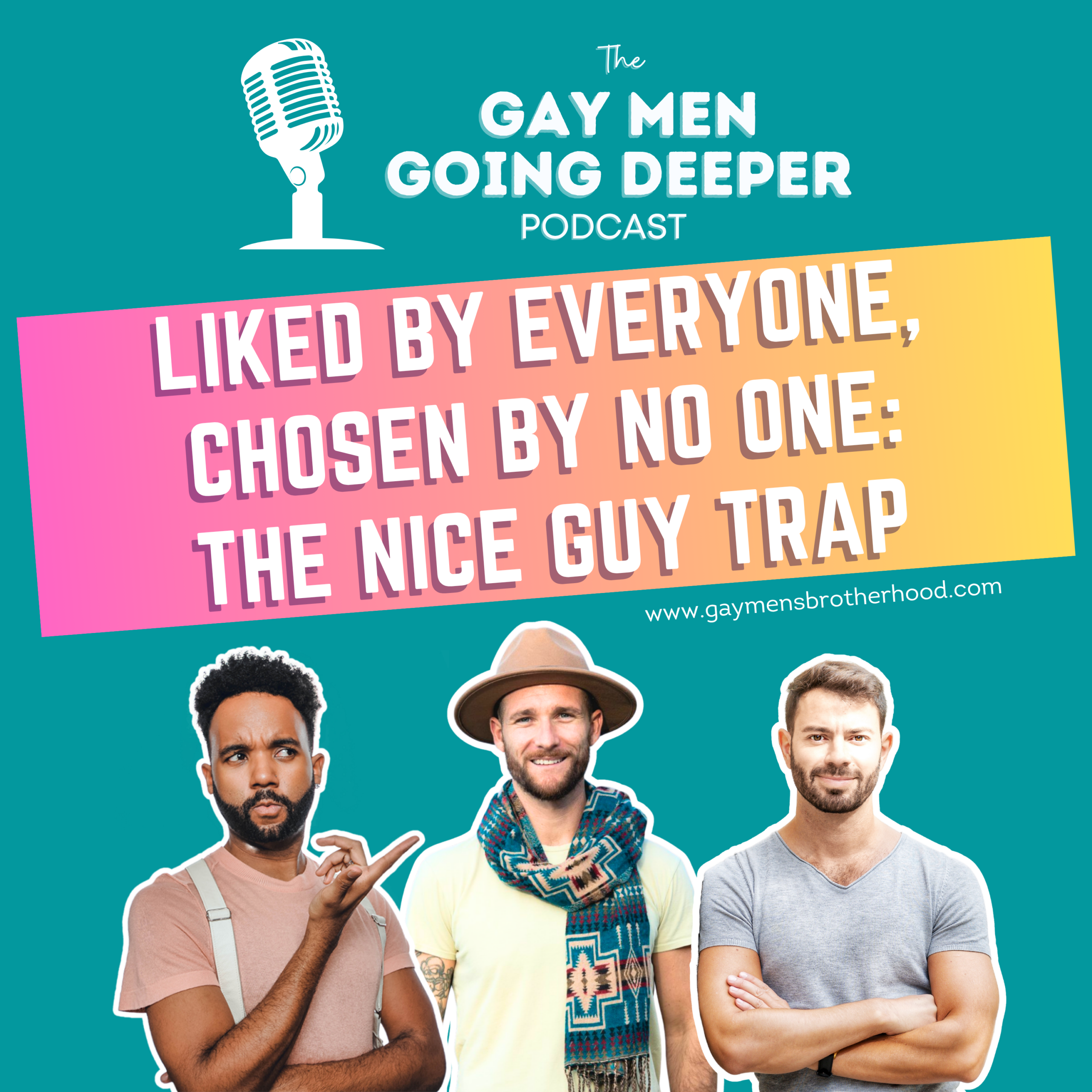
I am your host, Michael DiIorio, and joining me today are Matt Lansdel and Reno Johnston. Today we are talking about the Nice Guy trap, why nice guys are overlooked. We'll be talking about what does being a nice guy actually mean, why it backfires often in dating, and how to shift to being more valued and chosen. What we want you to get out of this episode is that knowing that you can be a good, kind person and still be valued, chosen and respected while still being completely true to who you are. Reminder that this podcast and YouTube channel are listener and viewer supported. So if you enjoy what we're creating, you can support the podcast by making a donation using the link in the show notes or you can tap on that thanks button on YouTube to show the podcast some love. All right, let's talk about this whole nice guys finish last concept. There. There is this idea out there that being nice is a virtue, that being the nice guy is the way to win in life, in dating, in relationships, in your career even. Basically, it's, you know, be easy, be agreeable, don't rock the boat, be nice. And on the surface, it works because, yeah, people like you. You're well received, you don't create any problems, you are nice guy. But there's a trend I've noticed with nice guys. Sure, they're liked, but they're not deeply desired, they're not sought after, they're not often chosen, they are friend zoned, they are looked over, they might be undervalued at work or easily taken for granted. So why is that? I think it's because what we call nice is often not kindness. It's more like a people pleasing strategy. Especially for a lot of us who are gay and grew up gay, we learned early that being liked is a safe thing and that's a good thing. So we got really good at putting our needs second to other people's and, and not to rock the boat, right? That's very common for gay guys. And it really does stem from that childhood mentality. Even if you're not gay, right? You know, be a good boy, be a good boy mentality. Parents and teachers drill that into us. For me personally, it was, you know, if I'm good, then I won't upset anyone. And that's a good thing. I'm a good boy, I'm gonna Make my parents happy, make my teachers happy, be a good student, and then that'll make me safe, that'll make me likable, that'll make me get love and attention and praise and make me feel good. But that's survival mode. And that worked then. Sure. But then as an adult, that can start to cost you because you don't say what you actually want for fear of rocking the boat. You avoid conflict, you avoid tense situations, hard conversations. You may over, give under, ask, not have clear boundaries, and then you end up being overlooked and then feel resentful about it. So that's what we're pulling apart today. We're going to pull apart specifically what nice actually is, that that's a word, the nice guy. We all have an idea of what that is, but we're going to get very clear on what that actually means and why it doesn't work the way we think it does, specifically in dating, and then how to shift that pattern to become more valued, respected and chosen. Key part here, while still being a kind and good person. Okay, all right, let's jump in. First question, what does being a nice guy actually mean to you? And today, let's start with Matt.
[00:03:23] Speaker C: Being a nice guy mean. I think I was kind of just discerning the two things between, like, the word nice for me is it feels fake. It's like how we are when we're making a first impression. It's like we're on our best behavior. We got to be really nice.
[00:03:36] Speaker B: Right.
[00:03:36] Speaker C: And it's like, it's not necessarily always authentic. Then the authentic version of. Of this would be like, kindness. And I love how you use that word because kindness is a something I feel in people. And it's just. It's a resonance, it's genuine. It's coming out of them. They embody it. Whereas nice feels like it has to come out of the mouth. Right. And it's like. So I think, like, nice for me is it's got an element of it. Well, the nice guy, I guess, has an element of, like, manipulation. Like, it's manipulative. They're trying to get you to like them. And there's probably an element of self abandonment and agreeability. And so it's like they're getting something for being nice. There's an exchange in that. So it's. I think you're right. It is very people pleasing. Yeah. Reminds. What came up was the story of. I think I might have shared on the podcast before, but I'll share it again, but I was dating a guy. And he was, like, just so amazing, right? And he was so sweet and. And he was kind.
But he also had that pleasing nature in him, too. So it was kind of. He had both, and it was not something I was attracted to. I actually broke up with him because he was too nice. And that was my reason for breaking up with him.
But I think it's dependent also on the person who's receiving this, the nice guy. Like, because there is the shadow side to that as well. Like, people are, like, repulsed by nice guys, guys that are going to treat them well or show up for them. Right. And it's maybe because they grew up not getting that. So there's. There's that shadowy piece where it's like they're attracted to the bad boy, the one that's going to treat them like. Like their father did or whatever. And there's that kind of attachment, negative attachment patterning that people play out. But I would still stand by what I said earlier, that the kindness is more so what? That kindness might not be able to be held in someone's nervous system. Right. The nice guy energy is. I think when somebody is kind of really congruent and authentic with themselves, they're going to feel that, like, no, this person is. And actually how it shows up for me is because another guy that I dated, too, he was very keen.
And I don't like that. I don't like keen. I don't like trying too hard to get me to like you or to be likable or do you know what I mean? There's an element of that. It's like, hey, you're trying too hard. So, yeah, I don't know. Those are just some of the things that come off the top of my
[00:05:44] Speaker B: head, you know, while I was thinking about this. Thank you. Thank you for that. While I was thinking about this. This topic. Exactly what you had said. Like, there's another episode here about being drawn to, like, the bad boys and the opposite of that. So maybe that's something we can flag another episode. Because that. That I think is a great discussion as well. Like that boundary and. And Matt, would your friends describe you as a nice guy?
[00:06:03] Speaker C: I think they would describe me as a kind guy.
[00:06:05] Speaker B: Yeah.
[00:06:06] Speaker C: Because I also have a fear side in me, too. Like, I'm not a pleaser and I speak my truth. And, yeah, I can. But was I a nice guy at a point in my life? I actually don't think so. I've.
[00:06:17] Speaker B: I've.
[00:06:17] Speaker C: I've got a bit of a. Of a defiant streak. In me. I'm a bit of a naughty boy when. When some. When you get to know me. Like, there's. There's, like, therapist Matt, and then there's, like, the other part of me.
I don't mean, like, going out partying, I call that. But it's just, like, there's something in me. Like, I have. I've always had that, like, I go against the grain in.
[00:06:36] Speaker B: And I have.
[00:06:36] Speaker C: Have for most of my life. So I. I don't.
[00:06:38] Speaker B: Yeah. Yeah.
[00:06:40] Speaker C: Interesting.
[00:06:40] Speaker B: Reno, what's your take on. On what. What is a nice guy? Would you have anything to add to that?
[00:06:44] Speaker A: Yeah, I was gonna say, like, I'm. And my friends would probably agree, like, I'm the most loving bitch you'll ever meet, because I just have, like, such a heart of gold. And also, like, I don't. I don't. I'm not shy to speak my truth. You know, I'm not shy to. To be honest and direct about my experience and, like, advocating for myself or just being honest and forthcoming about what, you know, what is true for me, what I'm experiencing. Yeah. Akin to. Matt, there's a distinction for me between nice and kind, you know, And I can remember hearing that word nice. You know, you often hear it when you're a kid. Be nice, be nice, be nice. Right? And ultimately, what's happening in that scenario is you are being invited, sometimes pushed, sometimes forced to abandon the truth of your currently lived experience. Right? And I've seen parents who are like, oh, be nice. Give him a hug. And I stopped them and said, hey, you actually don't have to do that. Like, I'm good if your kid doesn't want to hug me, because they're still assessing the situation, like, let them have that. Like, that's wisdom. That's intelligence in action. So let them be discerning. You know, they'll come to me when they're ready and when it's authentic to them. And so, yeah, so frequently you'll hear that, like, be nice, be nice. And I think kindness is something that emerges. It's not manufactured. You know, it's an emergence. We find ourselves being kind, and. And I think that tends to happen when we have taken care of ourselves. You know, I'm nice when I have to manufacture something that isn't naturally occurring to me. Right. But give me enough time, space, and I don't know. Yeah, I think kindness just kind of emerges. Yeah. That's how I would look at that distinction. And, you know, it's funny. I was saying to One of my girlfriends yesterday, sort of playfully, like in a. In a cheeky way. But I was saying, like, I love bitches, you know, And I, I was saying that because I've always really appreciated, like, women in particular. I, you know, I spent a lot of time around women, but like, people in general, as you. As you heard, I referred to myself as one too, who, who are just honest and direct about things. You know, I feel like that's something I can trust. And I'm not talking about people who are unkind. I'm not using that word as a. As synonymous with someone who's unkind or mean or just like unnecessarily, like rude or disrespectful. That's not what I mean. You know, someone who some. Yeah. Someone who is self advocating, you know, someone who is honest, direct, forthcoming, not withholding, not avoidant, etc. That's really attractive to me. Yeah.
[00:09:43] Speaker B: Yeah. The theme here that I'm hearing is that it's kind of a fake, inauthentic thing. Nice. And then kindness is naturally occurring. We are naturally kind people. And then that comes out. But kind does not necessarily mean nice all the time.
[00:09:58] Speaker A: Yeah. And the other thing I'll say too, to sort of piggyback on what Matt was saying previously is that I think sometimes we will engage in niceties, manufacture this niceness, because we're uncomfortable. Like what I felt in my body and my somatics, in my physiology when Matt was describing that keenness is that, you know, when we look at that keenness or we look at the niceness, et cetera, it's like, here's a great question. What are you avoiding? Because, you know, there's likely some uneasiness and a need to kind of like change and control the situation because your nervous system cannot handle what is in this moment. And so we resort to nice cities and performance and pretension and trying to sort of have things in a particular way. And I can only say this because, gosh, I've been there, you know, I get it. I just really want to know what's going on here. I just really want to control what's happening here because I can't hold it, you know, so that becomes the practice. It's like, okay, you know, how can I be with myself while being with another without abandoning myself, you know?
[00:11:11] Speaker C: Yeah.
[00:11:12] Speaker B: Reno. Have you ever been the nice guy?
[00:11:14] Speaker A: Yes. Yeah, definitely. Yeah, totally. I mean, what's funny is I've always been. I've always been pretty honest, direct and forthcoming. But I also. There are Moments where I've definitely, like, there's someone I really wanted to like me or there's someone who I really wanted to see me in a particular way.
[00:11:34] Speaker C: Like.
[00:11:34] Speaker A: Oh, I want. I. I want them to view me as this, like, soft, like, nice, approachable person. You know what I mean? Because then, you know, they'll pick me and if they pick me, then I am that. Right. So I was like, trying to perform something, hoping they would validate it so that it would be true rather than just being who I am, you know? And, and sometimes, like, that's, you know, that's like moody and. Right. Like it's just. And just honest and. Yeah, yeah, yeah, yes. So I've come a long way in some ways, but I would say for the most part, like, I've always kept it pretty real.
[00:12:12] Speaker B: Yeah, that's. That's what, that's what I. That's what I know you as. Yeah, he was the real guy.
[00:12:16] Speaker A: Yeah, yeah, yeah, yeah.
[00:12:18] Speaker B: What about you? Yeah, I think you guys covered most of it. I think that that pretty much sums it up really well. To me, nice is kind of safe. It's. It is. I agree. I think we all agree it's more of a putting it on kind of thing. Like a bit of a show. It's over agreeable, overly charming. It's inauthentic. And I think people can sense it. I mean, I certainly can sense it when you're turning it on. And it just doesn't sit right with me. Like, don't like. Yeah. And like, don't like you're being too nice. Like, I can just tell versus someone who's genuinely kind. I can sense the difference. It's. It's the difference between actually being good with anything. So in sense that, oh yeah, I'm good with anything versus like you actually have a preference. You're just not saying it and I can tell the difference. Or, or laughing something off that you actually might have a problem with or didn't sit. Didn't sit right with you, but you're like, ah, yeah, okay, whatever. Like, that's fine just to keep the peace. Or, or just because you don't want to speak up, which is. I mean, I get it, it's hard, right? But then what happens is we often do that thing where I'm saying we me previously, I was definitely the nice guy for a big part of my life where we over, give, over, give over, give over, give, Be good, be good, be good, be good. And yet I get nothing from it. Nothing real from it. And Then. And then wondering why I feel resentful. Right. So that was then. But I'll answer the question that I had for all of you guys, which was, would your friends consider you a nice guy? Which I thought was interesting. And for me, definitely not. My friends now would not. That would, that word would not show up. They would say that I am kind, absolutely. They would say that I'm generous a hundred percent. They'll say that I'm polite and well mannered, respectful and even easygoing because I am very easy going. But the difference is that, that kindness and everything I just said those, there's boundaries, very strong boundaries around that. So I'm kind until I'm not. I'm kind until I don't want to be kind. Or I'm kind until. Until. Until. Until or unless. I should say unless. And yes, I do advocate for myself. That's another thing that we all said. Right. So another common theme here is advocating for yourself. I will take a stand or a stand needs to be taken. I'm direct about what I want. I have no qualms about expressing what I need or what I want.
And if that makes you uncomfortable, that's fine. I'm going to allow you to have that reaction. You can feel uncomfortable with my needs and wants. That's fine with me. Holding boundaries. I do have boundaries. I say no a lot. And some people don't like when I say no. And again, it's okay, you don't have to like it. Right. So my friends would instead say, yes, I'm kind, generous, these things. But they'll also say things like, Michael does not mince his words or one I love is, you know, I always know where I stand with you. They'll say that to me like, I always know where I stand with you. And if I want the truth, I know you're going to give it to me. And I'd rather be that than a nice guy. Personally, I.
[00:14:51] Speaker A: Two things. One, I've always felt your edge and I find it attractive. It's. Yeah, I do. It's nice. I like, I like an edge. Yeah, it's. I, yeah, I don't know, there's. And there's a comfort in it, like knowing that some, like someone's not going to mince words. Knowing where you stand with someone, it's like, I don't know. Yeah, I like an edge.
And the other thing I was going to say is just the other day I had this experience with a friend because you can think of this in the context of dating and Relationships. But one of my very close friends, you know, we were interacting and I felt some passive aggressive undertones in how he was engaging me on a topic, and it didn't really feel good. And so, you know, there are times where I would have just, like, I would have been nice and played nice and sort of let it slide, but it affected me enough that I was able to, you know, to speak on it. And I just, I sent him a message later on and I just said, hey, I actually noticed some sadness and some hurt after our last interaction, and I would like to have a conversation with you about it so we can amend our relationship. And he's, you know, he said, like, I might be busy over the weekend, but, like, let's definitely check in Monday, if not tomorrow, you know, and so that is.
That is how I approach my relationships now. You know, it's like, I don't want to fight with you. I also don't want to make you, like, wrong or bad or whatever. I, I just address things directly and they speak to my experience. You know, the nice guy would have ignored that at his own expense and to his own detriment and the detriment of the relationship. Because what kind of relationship are you in if you can't be honest with yourself and the person you're engaging with? Like, my gosh, I don't want that. Yeah, totally.
[00:16:41] Speaker B: I love that example because you showed you can be kind, you could be respectful, be honest, be authentic. And again, so I wouldn't, I agree with you. I wouldn't call that necessarily the nice guy. I agree with what you had said the nice guy would do, but notice how all these things are maybe the ways that we would want to show up. But, you know, even as you were saying that right now, I was like, oh, that's, that's a hard conversation to have, or like, there's a little bit of resistance within me or tension within me to, to speak up. And I think that's where, that's where the niceness comes in. The nice guy will just say, never mind, I'm not going to do that. I'd rather just keep the peace, keep my mouth shut and let this, Let this relationship kind of dissolve or.
Yeah, yeah. All right. Matt, did you want to say something?
[00:17:18] Speaker C: Oh, yeah. I was going to say, like, you know, I'm trying to think about myself. I'm like, maybe there is a nice part in me, but it's. It comes from compassion more so than niceness. And it's like, because I have high empathy, I can Feel when people are hurt, and if I have to happen to be the one that hurt them, whether that's through rejection or needing to set a boundary or something, like, I can really feel that.
And sometimes I will not be as direct as I might want to or need to be. And I'll kind of, like, beat around the bush a little bit just because I know some people are really sensitive and.
And that's something that I want to maybe clean up a little bit, because I also know that sometimes I need to be straight, shoot straight with somebody, because especially in dating, like, sometimes I can beat around the bush and be like, oh, you know, I'm not in. I'm not looking for a relationship right now. And then, like, three months later, they message me again, like, are you ready now? And I'm like, I should have just said no. Sorry. I'm not interested in you. Like, I don't. I'm not attracted to you or whatever. Like, just be. Be honest about it. Do you know what I mean? So that can.
[00:18:18] Speaker A: I'm glad you named that, because you just put me on to this realization. Like, there's still subtle ways I'm clocking it now. Even as I'm sort of growing and evolving, I'm like, oh, yeah, I'm still nice here, here, and here. You know, these places where it's uncomfortable to lean into the truth. Like, I don't want to sit with the discomfort that I would experience and being even more honest in that situation. And I also don't want to make someone else feel more uncomfortable or uncomfortable at all. So I'm just like, okay, let me. Let me. Like, I do mince words a little bit still, you know, where it's. I don't know where. I guess where it feels really big, I'm like. Or where I'm concerned that it might be a lot for them or something like that or too confronting. Like, oh, I don't want to open up that can of worms. Let me just leave it be, you know? But I'm evolving. Yeah.
[00:19:14] Speaker B: The word that comes up for me, you know, I love words. Reno is all about nuance. I'm about. All about word choice. But notice the words we're saying, right? Instead of saying nice, which is this really blanket term, like, we're using really specific words here. Empathetic. The words that came. The word that came up for me in both of your shares there was considerate. You guys are considerate of how your words will land with someone. Right? We talked about compassion and kindness and all these things. Honesty. So, like, say those words then, right? Like those, Those. Those are what we're actually saying. And of course, we all have those moments when we have that nice guy moment or we're maybe people pleasing a bit for whatever reason we have, there is a difference. When that is your entire way of life, though, like, that is sort of your life strategy is to, like, be the nice guy. And that's kind of who we're talking to today or where that shows up. Some people shows up only in dating or in their work or in their family life. So just be mindful of, you know, where this pattern might show up within you.
[00:20:08] Speaker C: Yeah, good point.
[00:20:09] Speaker B: All right, let's hear from our audience. Where in your life are you being nice instead of being honest? And you can write that in the comments on YouTube. If you care to share with us and if you're enjoying the conversation we're having here, we invite you to join our sharing or our connection circles. Every month, we host two connection circles where Matt and I facilitate small, intimate conversations about the topics we discuss here on the podcast. But in a connection circle, we hear from you, our viewers and listeners. Put you guys in breakout rooms, and you have a chance to discuss, and then we'll bring you back into the main room and have a little debrief. Okay. If you're interested in joining our connection circle, go to gayman's brotherhood.com and check out our events section to see the topics and the times. Or even better, just get on our email list and we'll email you all the details. All right, we've been kind of talking about dating and how this shows up in dating, but let's dive into the dating piece, specifically nice guys and dating. Why does being a nice guy often backfire in dating and attraction?
[00:21:06] Speaker C: It's not real. It's not real. It's like, well, the last guy that I dated was like this. But I will say, underneath the nice guy Persona is a lot of rage and a lot of anger for having a lot of unmet needs. So it's like. And as an empath, I can feel that. So the dissonance between the niceness and the rage. I was like, whoa. Like, it's just. It's so intense to feel this. But what it's like is it's like dating like the mirror of you almost, because they don't. They don't have needs. They don't have a strong sense of self. So you're dating who they think they need to be to be with you.
[00:21:39] Speaker B: Right?
[00:21:40] Speaker C: And it's like, so it's a mirror of you and it's very confusing. Um, and. And I find that people like that aren't in their. In their power, right? They're trying to get power through changing perception and being friendly and being nice and all these things. So I think why it backfires in relationships is because it's like the power isn't there. Like the person's not in their power. So it's like when you're. When someone's in their power, like, there's going to be conflict, there's gonna be rupture and then repair, which is a real relationship, right. When someone's people pleasing, it's. It's a convenient relationship. And I think some people attract those because they don't want to be challenged. They don' to grow. But an authentic relationship is going to challenge you. It's going to make you grow. And I think so somebody.
And when you're dating somebody like that, it's only so long until it's just like, okay, like, wait a minute. I thought that you liked this, though. You told me last week that you like this, but you actually. And it's completely opposite. I started to notice all these, like, you know, he said one thing and then he's doing another or.
[00:22:35] Speaker B: Right.
[00:22:36] Speaker C: There was all these kind of discrepancies.
And so, yeah, it just, it comes up to. For me, it comes up to just like a lack of sense of self that hasn't been developed yet. Right. And so it's like, I got to be nice so that I can be liked and, and keep the peace and these sorts of things.
[00:22:51] Speaker A: So.
[00:22:52] Speaker C: Yeah, that's. I think that's probably the main way that I think it's just. It backfires in relationships because you're not really in a relationship with that person. You're in a relationship with their Persona or their facade. Right. And I'm talking purely the kindness piece that's inauthentic and like the people pleasing stuff.
[00:23:09] Speaker B: And people feel that you feel that, you know that.
[00:23:11] Speaker C: Oh, big time.
[00:23:13] Speaker B: Yeah. Yeah.
[00:23:13] Speaker A: Great.
[00:23:14] Speaker B: Well said. I completely agree. Reno. Reno, what's your take on that? Why does this backfire in dating?
[00:23:18] Speaker A: Yeah, Matt said it. Yeah, Matt said it very well. I think you're engaging. You know, my experience is like, you're engaging a shell of a person and inevitably the truth kind of comes to light anyway, you know, so you may as well bring forth like that truth sooner than later. You know, the other thing is it's manipulative. And even if you aren't the most in tune person. Again, inevitably it comes to the surface. You're doing yourself a disservice, and you're doing the other person a disservice. Because the beauty in my experience is that as you allow yourself to be made more authentic and you. And you realize your wholeness, you start to attract what is meant for you and true for you and aligned with you, you know, resonant and relevant with and for you. And that's a more beautiful thing than running through life trying to perform some version of yourself in the hope that you will get what you think you want. And the part of you that thinks you want that is the part of you that does not know that it's already whole and enough and amazing and awesome behind all of the stuff, you know, so. And I say that again, like, with the utmost tenderness and sincerity and love and kindness, because I understand it like, that was me. That's still me sometimes, you know, I haven't figured this out completely myself. Just the right person sometimes comes along and all of a sudden I'm regressing and it's activated some part of me that still needs to be made free and healed and. And recognize its wholeness. And it's like, you know, for you, listening, like, that might be, you know, the guy who looks like the guy who bullied you in early years school or, you know, the one who looks like your celebrity crush or whatever, and suddenly you've completely lost yourself and you're pretending to be someone you're not. That's. I think that's when we get into trouble in dating. But, yeah, I just practice being myself and being as honest as I can and recognizing that. I think that. I think that the thing I want to say is, like, it gets. It gets a lot more fun and it gets a lot more interesting when you enjoy being in relationship with yourself, you know, and you're not abandoning yourself, you know, to be nice and get who and what you think you want. And if you think about who you're attracted to, it's often the people who are, like, standing on business, like, in themselves, you know, comfortable, confident in themselves. And sometimes you'll see guys who aren't like, the most conventionally attractive people, right. By conventional standards, whatever that is.
But you're just, like, magnetized to them because they're just themselves. They're so straight up. They're so real. That's odd, you know?
[00:26:18] Speaker B: Yeah, we love to see that in others, and then it's hard for us to do that ourselves.
[00:26:22] Speaker A: Totally.
[00:26:23] Speaker B: Matt, what were you Gonna say it's.
[00:26:24] Speaker C: I said it's energy. I wish we lived in a world where more people were attuned to energy and not appearance.
I just think that especially gay men were so hyper focused on appearance. And it's like, I think energy is a much better currency. It's a much better way to evaluate somebody. And energy can't lie, Right, Reno, were
[00:26:48] Speaker B: you gonna say something?
[00:26:49] Speaker A: I. I said. Well, I said. I know I said it already. I. You know, I think just one other piece is like, yeah, that I. I said it before, and I'll kind of echo it. We're denying ourselves and each other, like, a beautiful opportunity. A beautiful opportunity to see ourselves and to, like, be witness and to be real in the world and in life. And so, yeah, I think it works in both directions. I just think, like, the person who's afraid to bring their honesty, to bring their authenticity, like, you're actually denying the person that you think you're helping. Like a beautiful opportunity to experience truth. Yeah, yeah, yeah.
[00:27:29] Speaker C: Well said.
[00:27:30] Speaker B: When I have dated or met nice guys, attractive as they may be, nice as they may be, what's missing for me is a spark. And I'm not. I'm not talking about physically, because they're very attractive, and I can find them physically attractive, like attention. And if you think about spark, a spark needs friction, right? To create spark, you need two rocks frictioning. And that's it. That's the missing piece, is there's no friction. Like, I'm not saying the whole thing needs to be friction. That's a whole. That's a whole other episode. But there does need to be, I think, some. I'm not saying disagreement, but if it's always agreeable, then it's not memorable, right? Like, I will probably go on a date with you, and if we disagree on something or if you have a different take on something, I'm going to remember that, and that's going to make you interesting and memorable to me, right? So when there's no tension on a date, when there's no tension with anyone, it just. It's just like, okay, cool. And then you kind of move on, right? So another thing that we kind of briefly touched on is actual conflict, right? I'm just talking about a little bit of disagreement. But conflict, real conflict, can, if you play your cards right, build intimacy. Let's get to know each other better through this conflict, right? But I'm not even going down the conflict path. But for people who are nice guys, conflict is conflict. And disagreement are like, no, we can't do that. So, again, you're going to get overlooked, I think, you know, because you're so busy managing, trying to be liked that you're not connecting with somebody. Right. Kind of like what you guys are saying. You're the shell.
[00:28:50] Speaker A: You're.
[00:28:50] Speaker B: You're kind of in your head. Make sure I say this right. Make sure I don't do this. Make sure I don't give that opinion. You know, whatever you think that you need to be, to. To be likable, that you become, you can't connect with that. That's a. That's a wall that's in front of you, an energetic wall between you and this other person. And so there's no chemistry. Of course there's no chemistry. You're not allowing yourself to get energetically. And so that predictability just becomes, I think, sparkless. And so people could see, like, oh, yeah, this guy's great on paper. He looks really good. He's done everything right on paper. I just not feeling the spark. That's what. That's what it is. That. That's what it is for me, at least.
[00:29:24] Speaker C: Well said, Mr. Michael.
[00:29:26] Speaker B: Yeah, well, you guys, I like going last because you guys always inspire.
[00:29:30] Speaker C: Going first is hard on the podcast. Podcast. Because I'm like, my juices aren't quite flowing yet.
[00:29:34] Speaker B: Yeah. Yeah, that's good, though. Okay. Yeah.
For our audience, tell us, if you've dated a nice guy or if you've been on dates with nice guys, what is it about them that you think doesn't. Doesn't pull you in? Maybe at the same time, you can tell us what does pull you in. All right. And remember a lot of the patterns that we're talking about here. Self confidence, dating, relationships, boundaries, communication are exactly the kinds of things we explore inside our coaching collection. 45 plus videos you can explore at your own pace. Plus you get lifetime access to our two courses, healing your shame and building better relationships, created by us and made specifically for you. Go to gaymangoingdeeper.com to get access to that. We have recently reduced the pricing on that, so go get it now. All right, this is the big question, the shift. Okay, so I think some guys out there might feeling. Might be feeling a little bit seen, might be something a little bit tender. Even. Even myself. I'm like, oh, yeah, that's. That was definitely me. So let's. Let's talk to them. Let's help them out. Even the parts within us that still are maybe a little bit of the nice guy. How do we shift from Being nice to being chosen.
[00:30:40] Speaker C: Yeah. So my, my connection circle last night was facing the fear of rejection. And this, I think this just blends in so perfectly. Because if you think about somebody who's nice and people pleasy they have a hard time tolerating emotion in their nervous system. And primarily I would say the emotion would be shame.
[00:30:58] Speaker B: Right.
[00:30:58] Speaker C: And specifically for gay men, it would be shame. And what does rejection cause us to feel? Shame. Right. Something's wrong with me. No one chose me, right.
So I'm going to be very agreeable, very likable, very nice. So then that way they like me. So I would say the shift happens when you start to work with your nervous system and you start building capacity in your nervous system for rejection. Right? And the dating arena is not the best place to build capacity for, for this in your nervous system. If I'm being completely honest, I think it's. That's like jumping into the deep end of the pool. Like, start small and start, like taking little risks where there might be little failures or little rejections that might happen along the way.
Ask for things from your friends where they might say no. Right. And like, start practicing tolerating that in that way and then move into the dating arena. Because when you're rejected in the dating arena, it can feel like, wow, like, they must really think I'm ugly or they must, you know, not like me as a person. And. But eventually, yeah, you're going to need to put yourself out there in the dating world because the dating pool is kind of like a numbers game and there's going to be rejection and it's inevitable. Even the hottest guy on this planet is still going to experience rejection. It's just how it works. Because not everyone on the planet is going to think he's the hottest guy on the planet. Right. And some people are not going to like, his energy or the way he shows up or whatever Rejection is, is inevitable. So learning how to build that tolerance in the nervous system is probably, I would say, paramount.
[00:32:22] Speaker A: That's.
[00:32:23] Speaker C: That's how that's going to happen. And then once that's starting to build, you can start to put yourself out there and practice having difficult conversations, practice setting boundaries, practice having needs, practice expressing your emotions in your relationships. Like all the things that are really foundational for authentic connecting. I think it's so, yeah, authenticity, it's the remedy to this all. But you have to build capacity in the nervous system to be authentic because it's not easy to be authentic and
[00:32:48] Speaker B: be uncomfortable, which is why that nervous System regulation is so key, as we say so often.
[00:32:52] Speaker C: Yeah, exactly.
[00:32:54] Speaker B: Reno, what about you?
[00:32:55] Speaker A: Yeah, in workshop, we have this phrase that we use. So we have this practice. In the Body Electric School workshops, we'll practice our no. So we'll go around and we'll, like, ask each other something. And you. You have to say no to the person. And the response, the person says back to you is, thank you for taking care of yourself. Thank you for taking care of yourself. And it's really beautiful because that's what that is. That your no. Is self care. Your yes, your authentic. No. Is self care. Your authentic. Yes. Is self care. Your authentic. I don't know, Is self care, you know, and so we thank people for taking care of themselves. Right. That's beautiful. I have this saying, and it's on my Instagram profile. It just sort of came to me one day. It was the person who has chosen themselves as a beautifully dangerous person. And I use that word dangerous playfully because you're sort of a glitch in the Matrix. You move through the world creating it, and you move through the world grounded and rooted in yourself. And rejection tends to be a less disruptive force and experience because we tend to fear rejection when we haven't said yes to ourselves. You know, when I say yes to ourselves, I mean, like, yes to being ourselves, yes to being enough, yes to being whole, yes to being adequate already.
You know, and so, you know, as you. As you practice that and. And practice, you know, becoming somebody you.
You love and want to be with, it gets. It gets a lot. It gets a lot easier to move through this space and shift from being the nice guy to being respected and actually chosen, because you've already done that. Like, you're already respecting yourself. You've already chosen yourself. So you're not out there trying to manipulate the world to fulfill that need because you've already done it. That box is checked. And like, to make it real, to make it really real that, you know, that's waking up and literally, like, being with yourself, cultivating a practice where. And I don't get this right every day, like, I reach for my phone first thing in the morning often, you know, so I'm not out here saying, like, oh, I know this and I get it right every day. But certainly I spend a lot of time with myself, getting familiar and comfortable and, like, in cahoots with myself, you know, and it just makes it easier for me to move through the world in an honest way, you know, and having chosen myself. So that's. That's that's my. My suggestion or my invitation to folks who are listening and they're like, well, how do I. Like how do I do this? You know, it's like, yeah, go for walks, meditate, journal. Like, get intimate with yourself, which is ultimately choosing yourself and choosing to be with yourself and. And get comfortable with what comes up when you're being with yourself, right? Because that's what's real. And as you. You start to allow that to come up and not evade it and run away from it, what starts to happen is you get more and more comfortable with being with yourself. And like Matt had said earlier, we're energetic beings, right? We're not just human beings. We're also spiritual and energetic beings. So we feel that, right? We feel when someone's incongruent or inauthentic. And so the more more you own that and the more you enjoy being with yourself, the more people are going to be like, what's that? What's going on over there? You know, you, like, magnetize people. You become a magnet, you know, and you're good, which is great. Like, you're like, that's great. Like icing on the cake, sprinkles. I don't, like, I don't necessarily need it, you know, because I'm already, like, cool with myself. I got a friend right here. But I would love more friends. I would love more lovers. I would love more, you know? Yeah.
[00:37:00] Speaker B: Yeah, Both. Both of you guys nailed it. Yeah. Trying to think of myself, you know, my.
I am naturally very agreeable. Literally, like, you like, anything goes with me. I can have a good time anywhere. I am, like, I'm very agreeable and it's authentic. Like, I'm not just people pleasing. It's just like, I'm really good at that. So I tend to be like that almost. It might seem passive. Like, sure, yeah, I'm good. I'm down with whatever. Like, that kind of thing. I'm good with whatever because I actually am good with whatever. But it's good practice. If that sounds like you out there. It's a good practice to actually. Even if you are good with whatever, practice leading. Even if you're good with whatever. If you're good with whatever, then it should mean that you can pick whatever you want. But for me, the hesitation was, I don't want to upset the other person or I don't want to. I want to have them say no, or I don't want to pick the wrong thing if I'm the one picking the date or picking where to eat. I used to be like, what if I pick the wrong restaurant? What if he doesn't like Indian? Or what if he doesn't like tired? What if it doesn't want to go that far? And so even though it was fine with me, literally, whatever. I was just so afraid of leading because I didn't want to upset him. Oh, if this sounds like you practice leading, practice initiating. Don't wait for the text. Send the first text. Don't wait to say, hey, I'm going to wait to see what he says. You lead the way. Even if. Even if you've already texted. Right. Do it again. Like, that's the discomfort. These are some of the small ways you can practice that. That discomfort of leading, of being honest and authentic. Because what happens is, for me, I would be like, whatever I say is going to depend on what he says first. So he's going to say something, and then that's going to dictate what I say. And I think a lot of people do that. Versus I genuinely had an opinion. Either I'd like this guy and I want to see me in, or I don't. I don't really want to do this anymore, and I don't want to see him again. But I would wait to see what he said first before I gave mine. Right. That's being the nice guy. So don't do that.
Say what you want first. Hey, I'd love that. I'd like to see you again. Or hey, no, that was a nice day we had. Unfortunately, I don't feel the spark. Whatever. Whatever. So go from kind of reacting to directing the. The. The play in dating. I'm talking specifically about dating. I could have a whole other thing here about how this shows up at work, because it did for me. But that's maybe another episode. But, yeah, try. Try leading and be. Instead of agreeable, be intentional. Yeah, that's my advice.
[00:39:12] Speaker C: Yeah. Go for what you want.
[00:39:13] Speaker B: Yeah, go for what you want.
[00:39:15] Speaker C: Life's too short.
[00:39:16] Speaker A: Yeah, it's. It. Yeah. Please, Michael.
[00:39:18] Speaker B: Yeah, and say that clearly. Like, state it clearly. Like, this is what I want. Like, that. That for me, there was a time in my life that was very scary. I had things I wanted, but I shouldn't say that. Right. I don't want to say that out loud because people might not like it or people might not want to give me that. And I was so afraid of the. No. Afraid of the rejection. Yeah, go ahead, Reno.
[00:39:36] Speaker A: Yeah, it's a. It's a. Your authenticity becomes a filter. You know, I Just keep seeing that so frequently. And like, I have so much empathy for the scared part. Like, I even say this with tenderness. Like, I have so much empathy and compassion increasingly and love for, like, the scared part of me that's like, I. I kinda. There's a part of me that does want everyone to like me, you know, and that does want to be picked and chosen and, you know, and like, agreeable and wants things to be smooth and doesn't want to rock the boat and likes peace and love and harmony and all that fun stuff. Right. And. And you, and you don't. You don't get there by faking it. That's what I've learned. You just. You don't get there by faking it. And what's been so beautiful about my own journey, especially like this last year, I've learned so much, is that I'm just. I'm increasingly willing to, like, tell the truth, to rock the boat and to let go of what isn't in alignment. And that can be really scary. Like, one of my closest friendships, it was a newer one, you know, some. Some years new, but let that relationship go earlier this year, you know, and then there was a date I was on a little while ago, and I was just honest with this gentleman about, like, what I was experiencing. And I said to him directly, I said, you know, I'm going to say this with kindness and I'm going to say, I don't, like, I don't want you to change. I don't want you to be anything you're not. I'm naming what's in the room. And I said, I don't feel like there would be room for me in this relationship, if I'm being honest. Like, there just isn't right now. It seems like there isn't really room for anybody else. Right. And so I'm just being forthcoming about that. You don't need to change. You don't need to feel shame or guilt or like you've done something wrong. Just keep being you. If this is what's true for you, then keep honoring that, you know, and so we. We sort of gravitated away from each other. Right. But if I thought that this person in front of me was the person who completed me and, you know, filled all the gaps and was my reason for being. Whatever, whatever, like, oh, my gosh, what a mess, you know, so it's beautiful because when you. Yeah. Like, as I get more and more comfortable with myself and choosing myself, it's like I don't put myself in Those situations anymore, you know? Yeah.
[00:41:59] Speaker B: I didn't know you had that streak in Urina where I guess I. I guess I've only known this part of you. So it's. It's hard for me to imagine you as like, the nice guy. But yeah, you know, it's a good point you made about we all. Of course, we all want to be liked. And we all. We all like that. That's. That's human nature. But at what cost, I think, is the next piece of that? Like, what's the cost of being liked by everyone? Right?
Yeah. Probably not liked by yourself. You could probably be liked by everyone except for yourself. True.
[00:42:22] Speaker A: Yeah.
[00:42:23] Speaker B: Yeah.
[00:42:23] Speaker C: I think it's impossible to be liked by everybody.
[00:42:25] Speaker B: Of course.
[00:42:26] Speaker C: I think what I try and focus on is like, being good at repair. Because if you're good at repair, even if somebody. You piss somebody off or somebody doesn't like you, you can repair with them. I think about, like, all the people that I've had conflict with. I don't hate them anymore. It's just whatever, you know, it's like I don't really have many enemies or people in this world that I truly hate because guess what? I grew out of it or over it. And I.
[00:42:50] Speaker B: Right.
[00:42:51] Speaker C: So I always just think that, like, whenever I have to go into conflict with somebody, it's like, I know that there can be a repair at the end of this where they're. It's temporary. That they're going to have disdain for me. Right. Because if I repair with them, then there's the disdain can turn into, as you said, Michael, like more intimacy or just even neutrality. So, yeah, mature people, the people you want to relate with, they'll get over not liking you if you have to speak your truth or set a boundary or be in conflict.
[00:43:16] Speaker B: Like, otherwise they're not for you.
[00:43:18] Speaker C: Yeah. If people can't get over it and they have to. They have a hard on for you for the rest of their life, then that's just. They're revealing their emotional maturity level.
[00:43:24] Speaker A: Not. Not the good kind. Right.
[00:43:26] Speaker C: Not the good heart.
[00:43:27] Speaker A: I'm like, please have a hard on for me. I love it.
[00:43:30] Speaker B: I work with a lot of guys who would consider themselves people pleasers or. And I'm just thinking about them as we're having this conversation, and one thing they'll say is, oh, but if I do that, I'm not gonna be good. It's almost like I need to be this good boy. Or. Or they think that they're suddenly going to be a bad person. So I just want to add that I think that's an important question. What would you say to that fear of, like, if I stand up for myself, all these things that we just suggested are amazing, but it's probably going to be met with some kind of resistance about not being a good person, whatever that story is about, or not being, you know, just good. How would you respond to that? Either one of you?
[00:44:03] Speaker C: I think it's inevitable. Like, let yourself be perceived however people need to perceive you. I always say, let you know, be the villain in people's story if they need you to be the villain, or be the hero in people straight if they need you to be the hero. Like, you'll never be able to control that. So some people are going to see you as, you know, a bad person or, you know, like, and when you're public. And that's how I think I've done a lot of healing around this being public. People are always projecting onto you, right? And I feel like I just had to, like, I used to try and micromanage it and I felt like I was juggling a zillion things. I'm like, I have to manage all my. These perceptions and. And then I had this beautiful. In the last few years, I've just surrendered. I stopped caring and I'm like, I can't, I can't keep juggling. It's exhausting. I burnt my juggling and then I surrendered into this carelessness. And now I'm kind of like, okay, great. Like, if you need to project onto me, like, you know, it's fine. So, yeah, let yourself be the bad boy and try that hat on and see what it feels like. But again, you have to be able to tolerate that in your nervous system. It's. This isn't just a switch and we can just switch into new concepts because we have to have the nervous system capacity to hold the new concept. Right? So it's like learning to embody like, capacity. It's just, it's everything really, I think. So work with somebody that's like trained in helping you build capacity in your nervous system, whether that's like somatic therapy or, I don't know, yoga therapy. Like all the, all the expressive art therapies, I think are really good for working with the nervous system and stuff.
[00:45:28] Speaker A: I don't think we'll have to edit
[00:45:30] Speaker B: this out, but I love sentences that start with that.
[00:45:33] Speaker A: Right? But, but, well, okay, so maybe I'll just say the F word, like the FA word. But someone, someone in Heart Circle recently had Shared that someone had. Had. Had used that word and it. And it. And it bothered them. Faggot, right?
Yeah, yeah, yeah, yeah. So. So. And I remember it was so interesting because his impulse was to want to punch the guy and listen. Like, I'm scrappy. So there was a time when, like, me, too. I would have been like, let's go. You know, But. But like, now when I hear people say stuff like that, it's. It's actually. It's amusing. It's amusing. And I've been called every name and word in the book in my time, you know, and, gosh, it crushed me when I was younger. Because you're like, you don't even know what it means. You just know the energy behind it. Right. But, like. And it doesn't feel good. I've learned through wisdom and lived experience that what people think is, like, it's none of my business.
And it actually doesn't have anything to do with me. It doesn't mean anything about me. So it was interesting hearing him share that, because I had zero trigger. Like, I was like, I actually. I'd probably be like, hey, girl. You know what I mean? Like, that's probably what I do, because I don't care. It's not. It's not a threatening statement to me. It means nothing to me. And it's really a reflection of you and your. You know. So I like what you said, Matt. Like, less and less am I running around trying to, like, mitigate and control and manipulate people's thinking. Because it's like, it's hard enough to, like, work with my own. Like, I. It's like I'd be a crazy if I was believing everything I was thinking. So why would I believe everything other people are thinking? You know what I mean? Why not just keep it real? Right? So. And then, yeah, if you. If you're with me, with me, if you're not, like, that's cool, you know? Yeah.
[00:47:29] Speaker B: And that's what makes people attractive, memorable, chosen.
Right. It's taking a stand.
Even if you don't necessarily agree, you will remember them. And that's how that works. Right. Whereas when you don't do that, like we talked about, you're just going to fade. Fade to the back. Like, no one. No one's going to remember you. No one's going to choose that. So there's so much to gain from this. There's so much to gain from this work of not being the nice guy and whatever stories you have around that there's so much to gain if you can get over that fear. Everything we've talked about, the fear of how people might see you, but it is so much worth it. I can say that because I have have been the best good little boy you'll ever see, right? I have done that. And I have done that for many years. And maybe 10 years ago, switch and my life changed completely in all the best ways. So I do encourage anyone out there who might feel a little bit tender with this conversation that we're coming at you. I promise. There's. There's a way out. All right, Any last words, guys? Amazing. Well, thank you both for your wisdom and insight as always on this episode. Thank you to our viewers and listeners for listening and sticking with us. If you're on YouTube, now is a great time to tap on that thanks button to support the game on Brotherhood and the podcast. Also, guys, you can subscribe to get episodes before they are released to the public on Apple Podcasts. So go there and subscribe and you'll get access to probably 2, 3 episodes ahead of time. Right. All your support helps us to continue making content and supporting our community. So we thank you so much in advance and we'll see you in two weeks. Bye, guys.