Episode Transcript
[00:00:00] Speaker A: Foreign.
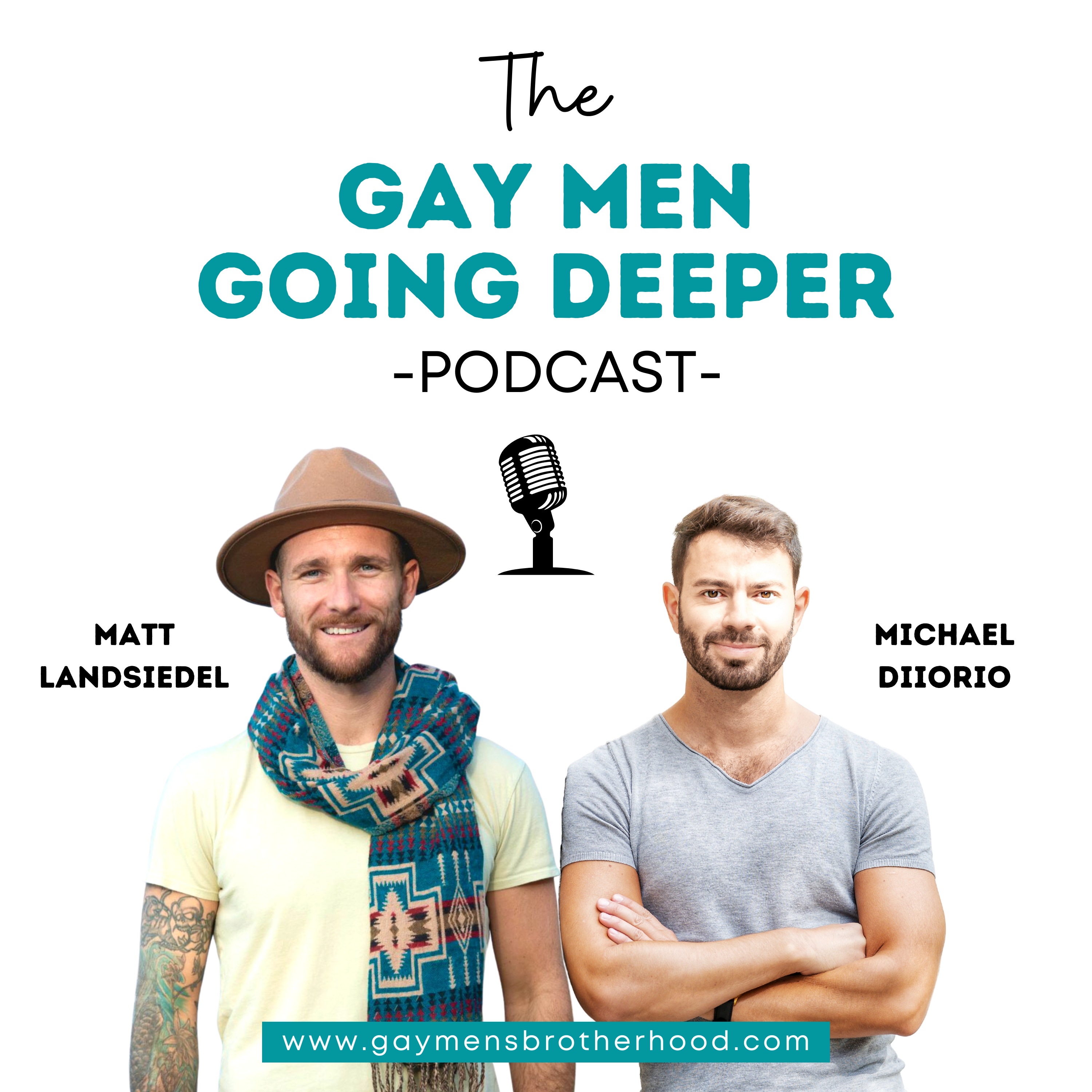
[00:00:04] Speaker B: Welcome to Gay Men Going Deeper, a podcast by the Gay Men's Brotherhood that showcases raw and real conversations about personal development, mental health and sexuality from an unapologetically gay perspective. I'm your host Matt Lansdell, and joining me today is my lovely co host, Michael Diorio. So today we're talking about over identifying with being gay. Is this helpful or is this a hindrance? And what we want you to get out of this episode is just a deeper insight into the wholeness of who you are. There's a lot more to us than just our gay identity, so we want to explore that. But there's also benefit in identifying as gay and having subgroups and having a culture and a community to belong to. So we're going to look at when it can be helpful to identify as being gay and when it's might be helpful to let go of this identity. So this, the inspiration of this topic came from my probably 10th time reading this book. So if you're listening and not watching on YouTube, the book is the Power of Now by Eckhart Tolle. So this is probably one of the one of the top five books that has influenced my life the most and my spiritual practice. So I've read it a lot and I was reading it recently and there's a quote in here and I think I've shared on the podcast maybe like five years ago, it was a very, very early on. So I'm going to, I'm going to share it again. So the book is kind of organized in the sense of like questions. And then he answers the questions right. So one of the questions is in the quest for enlightenment, is being gay a or a hindrance or does it not make any difference? And he goes on to say, as you approach adulthood, uncertainty about your sexuality, followed by the realization that you are different from others, may force you to disidentify from socially conditioned patterns of thought and behavior. This will automatically raise your level of consciousness above that of the unconscious majority whose members unquestioningly take on aboard all inherited patterns. In that respect, being gay can be a help being an outsider to some extent. Someone who does not fit in with others or is rejected by them for whatever reason makes life difficult. But it also places you at an at an advantage as far as enlightenment is concerned. It takes you out of unconsciousness almost by force. On the other hand, if you then develop a sense of identity based on your gayness, you have escaped one trap only to fall into another. You will play roles and games dictated by a mental image you have of yourself as gay, you will become unconscious. You will. You will become unreal underneath your ego mask. You will become very unhappy if this happens to you. Being gay will have become a hindrance, but you always get another chance, of course, Acute. He's talking about this more on the sense of a spiritual path and how on the spiritual path we. We shed identity. That's. That's basically what ego death is. It's the shedding of identity of, or the personalities that we hold on to for dear life based off of self concept, how people treat us.
So while there is an advantage, right, to being gay, he's saying that we can. It can help us, but if we hold on too tightly to the identity and we play out roles or stereotypes, which is, again, what I see a lot of in. In the community is people really struggling with. With sense of self. Right. Growing up, we have to hide our authentic self, so we develop this kind of faux sense of self or these Personas, and we're. We're interacting with the world through this. This perspective leads to a lot of loneliness, Right. A lot of disconnection from people, and I think it's when we start to connect with our authenticity and that we actually start to alleviate some of that loneliness.
Yeah. So I just want to. I just wanted to explore this. I think there's something in. In here that needs to be said, and I feel like I want to say it. So I'm just curious. Let's start just from the. From the beginning of, like, how do you identify with being gay, Michael? Like, what are some of the things about being gay that you really grab onto, that these are, like, part of your identity?
[00:03:47] Speaker A: Yeah, a lot of it, I would say. One thing I love and that I'm so proud of in terms of being a gay man, being part of the lgbtq, is that our existence is rebellious. And I love that I am. I am a little bit of a rebel. I've talked about being, you know, like, subverting the norms. I. I love questioning norms. I. I love just being a little bit of a rebel. And I think the queer folks have done that, and that's what our. Our existence proves that. Right? And not just.
Not just the things like who we love and how we love, but also, like, our expression. If you look historically, queer folks have been at the forefront of, like, amazing art and music, fashion, architecture, cuisine. Like, I just love that we do that because I think for a lot of us being othered in the world, and once we kind of get pushed out of out of the common folk. We are just liberated. And that allows us to naturally be a little bit more kind of with that I don't give a fuck attitude. It's like, well, you know what? I'm already othered, so watch this while I'm here. I'm going to do this and I'm going to start wearing these clothes and I'm going to start doing these things and I don't care because I've escaped the social norm of the straight world where I have a lot more freedom to do what I want. And I think that's why homophobic, homophobic people don't like a lot of us because they see some of us, all of us, living that authentically gay, as I call it, shamelessly gay, unapologetically gay life. And they can't stand it because they are stuck in the social construct of straight world. And that can be, historically speaking, very limiting.
[00:05:16] Speaker B: Yeah, it's interesting because I think that's what Eckhart Tolle is saying. He's basically saying that we, we escape, that we escape the unconscious majority. But then to go into what we would say is we're liberating ourselves from that to go into a minority. Right, but does the same thing not happen then in that minority group? It's like we are then therefore playing the roles that we have been taught what of what it is to be gay. So we're just literally falling from one trap into another when it comes to, I would call it over identifying. Right. And at what point is identifying and over identifying, what's that line between when we over identify with being gay where we're grabbing onto this identity like for dear life? And maybe it is, you know, I remember doing an episode on heterophobia and that's to me, where we start to over identify with being gay when we're like, you know, everything has to be gay. Like, I play gay hockey, I play gay dodgeball, I go to gay this, gay that, and I won't go to anything that doesn't have the word gay before it. That to me is an over identification with, with gayness. Because there's other amazing people on this planet too that aren't gay that we can also connect with and learn from and grow with as well. So that's maybe where I would. My inspiration behind the topic was maybe that line between over identifying and identifying us as being gay.
[00:06:29] Speaker A: And there absolutely is a line. It's a really good question and it's one that, you know, I think everyone listening should kind of ask themselves, you Know that, you know, heterophobia, clinging on to things, having to be gay before you join them or people you talk to. Like, look around at your friend group. Do you have a mix, right? Do you do activities or can you do activities that are not necessarily gay things? Those are good questions for me. It's definitely a part of me, but full. Definitely not all of me. Like, when I look at the fullness of who I am, when I step into, like, Michael, being gay is. Is a part of it, big part of it, but a part of it. But certainly not the whole piece. And certainly not the first thing I would describe myself as. I mean, I identify with a lot of things. I identify with being Canadian, identify with being a man. I identify with being CIS gendered. I identify with having an Italian background and a Catholic background. There's so many things I identify with. An entrepreneur.
All of these pieces make up the fullness of who we are, and gayness is one of them and one that I love very deeply. And I will say this, I have a special connection with the gay part of me because for so long it was a piece that I hated and there was a lot of shame and I hit it and I. And I felt like it was limiting and it was a cage that I had to live in. And I think it's special to me now because the complete shift I've made on that, it has now become one of my greatest strengths. I love that I had to go through all of that adversity to get to the man I am today. And I think it just makes me a much more confident, resilient, strong, creative, resourceful person.
[00:07:55] Speaker B: Yeah, I like that. I like that. I see, I like, I feel the same way. Like if I'm like, if I get to choose my incarnation, I want to come back as a gay man again. But with what I know now and all the work I've done now, I don't want to go back to how it was when I was like 18 and I was drug addicted, addicted. And I really hated myself and I don't want to go back to that.
[00:08:12] Speaker A: But you know what though, Matt? I think that your. That that journey, just like with me, it's the journey that got. That made us who we are now. So it's almost like, no, of course we don't want to go back there, but it's that it's the man you became, the man we became. Having to go through that, the introspection and the pain and all the self work we had to do and the inner Work we had to do is what brought us to who we are. And sometimes I look at, you know, people who have very privileged lives with no challenge, and I feel kind of sorry for them because they're. They have that, like. I don't know, what's the word? Like, elitist. Kind of like, I deserve everything. It should be easy. And then they're the ones who, as soon as adversity happens, they, like, panic and they flounder and they collapse because they've never had to deal with adversity.
[00:08:53] Speaker B: Yeah.
[00:08:54] Speaker A: Yeah, yeah, yeah.
[00:08:55] Speaker B: Interesting, this whole concept of identity, because I'm. I'm. I'm going through an interesting period in my life. Have. For three years, I've talked very openly about this on lots of the episodes. Most of the audience knows just a big giant rebirth, shedding, gr. Whatever you want to call it, spiritual awakening. But it's been going on for three years now, and a lot of it has been centered around identity and letting go of things I've identified with that aren't serving me anymore. But there's a lot of pain and grief around having to let those things go because their identity serves a purpose. Right? Identity provides us with belonging, validation, protection, deeper understanding of ourselves, like these sorts of things. So when our identity starts to shift, especially if it's happening not by choice, right. I guess ultimately by choice, because I choose to live a spiritual path, so that's the choice. But I don't. I don't want to have to go through the suffering, I guess, to get there, is what. What I'm saying. But if you think about it like the. The identity of being gay when I was younger, right, I. I was identifying with it, but from a place of. I don't like this. I don't like this about myself. And it created shame. And now the identity that I have around being gay, I've been able to take that and I've been able to kind of shape it to my unique gayness. And that's why I think being gay, it gets. We get to define what that. That what that means for us. But a lot of my work has been detaching from the identities that I thought I had to be in order to belong or fit into the gay. The gay culture, which that was not me, right? Which is why I rejected the identity for so long and why I was like, oh, I don't like this community. I don't like this. Because I wasn't maybe. What's the word I'm looking for? I wasn't maybe individuated enough from the community, like, I hadn't done enough work on my. To be able to say, okay, I can be an individual in this community and I can, I can grab on to whatever I want that is going to define me as a gay man. Not like, you know, all the things that. And some of the things that irritate me, actually, where I don't, where I didn't want to identify is the, the pieces that I think we get judged for by greater culture, like, mostly heteronormative culture around being gay, like, being deviant and being like, super hypersexual and the cruising culture, and all these things that we get viewed as is like, like perverts or whatever. You know what I mean? Like, which I know I'm not saying that if you cruise, you're a pervert, but there is, there is that. That energy out there that people project onto us, that we have that. And I just, I wanted to detach myself from that identity to a certain point where I was like, you know what? This isn't who I am. And if, if people are going to, you know, judge that the culture that I don't have to be. I don't have to take that on. I don't have to be. Like, this is a part of who I am. Right. So, yeah, it's just been interesting.
[00:11:29] Speaker A: Yeah, it's. It's a, A good lesson to learn.
I think that in that case, for me, it doesn't bother me that much because I think I'm so grounded now in who I am. And so people want to judge the gay community as a whole and lock me in there with it. I'm like, well, that's on you. Like, you're missing out on the individual that is me. And if you want to do that, you want to paint me with that brush. Doesn't bother me too, too much. I can see how. Yeah, there are times where, like, I will. I will watch gay men and I've talked about on this podcast, I will, like, listen and overhear them. And I'm just like, I can't. I'm not like you. We may both be attracted to the same sex, but we are nothing like each other. But this is true for any kind of quote unquote culture, any kind of group. Like, you and I are both Canadian. Lord knows there are a lot of Canadians that we have some things in common and some things we're completely separate.
[00:12:16] Speaker B: Yeah.
[00:12:16] Speaker A: And so this is the true forever for anything. Right. It's just. I love the word that you use. The. The individual. Like, yes, you. We still are individuals, even though we're part of a community. It does not mean that we need to betray who we are, our authenticity, just to fit in and kind of mold into the soup of gayness. You seem to be who you want to be.
[00:12:37] Speaker B: Yeah. Yeah. It's interesting that, you know, you talk about being Canadian or you could even talk about being white or these sorts of things and being lumped in. I look at those things more as, like. Like cultures. Right. And I look at being gay as, like, a subculture. I wouldn't really call being gay like a culture. I think it's. It's smaller. Right. People don't look at, like, being gay as a country or a race. Like it's a sexual orientation. And I feel like. I don't know, that's just kind of how I look at it. So it's not as, like, vast. And I don't think there's as much mainstream rep. Mainstream representation of diversity within gay culture that is being put out there that people would actually look at is like, there's a bunch of different gay people.
I don't think people look at it like that unless they're very educated. I think they just lump us all into this one subgroup of, like, you guys are gay.
That's just. That's my own. My own opinion of it.
[00:13:27] Speaker A: I agree with the part that if there's someone to blame here, but with the part that the mainstream does not do us justice and does not do a service, and I don't know whose fault that is. Is that the gay people's fault? Is that media? I don't know. But the point is, yes, I agree that, you know, there's a image I shared in the Gay Men's Brotherhood Facebook group, and a few people have shared it since. I don't know whose it is, but it's this iceberg of, like, gay gay culture. And on the top of the iceberg, above the ocean, you see, like, white fit guys partying under this cabal with, like, rainbows. And then, like, under the. Under the ocean, the bottom part of the iceberg is everybody else. But it's still there. It's still there. That does not mean that it's not there. So I think there's a difference about mainstream and what's maybe promoted and what people see when they think gay. Like, what's the first image that comes to your mind is probably that. And I think that. I agree with you there, but I do see gay as a culture, even though it's not like a race, like, physically. I do see it as a common people with a common. Something in common that puts us kind of together, whether we want to be or not.
[00:14:25] Speaker B: What is that thing, do you think? What's the thing that brings us together
[00:14:28] Speaker A: in common, the way we love and the people that we are attracted to, we're attracted to the same sex instead of everybody else who's attracted to the opposite sex. So that puts us together.
[00:14:37] Speaker B: Yeah, I agree. And I think that's why I would call it a subculture, because I think the thing that. That people view when they think the word gay, they think, like, sex, attraction. Right. So the. The. This whole ideology around sex is then lumped into it. I like how you said it's who we love, because that's a big part of it too. Being gay is not just about sex. It's about the fact that we. We love this. But I do think that mainstream culture looks at that, and they don't really see it. That's not the first thing they see. And I would love if media portrayed more of those sorts of things. And not just that, but that's where I think we do a bad job at marketing. I think gay men do a bad job at marketing themselves and our community. And.
[00:15:14] Speaker A: Because.
[00:15:14] Speaker B: Right. Like, you look at gay pride parades, and that's, like, one of the things that gets a lot of media attention. And there, it's just very, very sensationalized and sexualized. So I do think that's a piece where maybe we need to look at how can we promote that. That other part of ourselves, Right. That identity, which is that we. We love each other. We. We can have families, we can adopt kids together. Like, there's so much more, like, wholesomeness to being gay than just the fact that we have sex with other men.
[00:15:41] Speaker A: Right. Yeah. Completely agree. And I think that's what this podcast does. And if you think about it, a lot of the episodes. I'd say most of the episodes are completely relatable to straight.
[00:15:52] Speaker B: Yeah.
[00:15:52] Speaker A: 100. We just look at it from our lens, from that unapologetically. Unapologetically gay lens, as we say. But, like, all these are universal human things. We talk about shame, rejection, fear, intimacy. You know, this is all human stuff. And so, yes, we have our own flavor of it coming at it from gay. From a gay perspective. But, yeah, we need to sometimes zoom out. And that's what I like to say is, like, zoom out of the gay thing for a second and, like, recognize that you are a human.
[00:16:19] Speaker B: Yeah, like.
[00:16:19] Speaker A: Or you are energy. If you want to go even further, you're just, you're. You're human. Who has human experiences. And whether you're gay, straight, black, white, wherever you're born in the world, however old you are, there are common human experiences that I think when we tap into that, we can zoom out from that identity and zoom into empathy.
[00:16:38] Speaker B: Yes. Yeah, I like that. With the whole, with the broader whole. Right. Because when we're. Identity helps us create cohesiveness and togetherness within our subgroup, but then it can also be the thing that divides us and others, ourselves from the larger group. So how can we have a nice balance of like, yes, I'm part of this, this subculture or culture, whatever you want to define it as, but then I also have like all these other things. Like, I look at. My gayness is like 10% of who I am. Like, I identify with it around a 10%. I'll say the other 90% of me is like all the other things. I'm a therapist, I'm a son, I'm a dog dad, like, right. I have these other identities that I, that I'm living. And each, each one of those things actually can bring us into other communities or cultures. But I do think the more that we can identify with, like the humanness, that really is what ties us into the larger whole, we'll call it.
[00:17:29] Speaker A: Yeah, yeah, it's. It's when we outsource our entire personality to any, anything, whatever that may be. Right.
In this case, being gay, if that becomes all of who you are and your entire personality, you miss out on so much and you start to then other others. So, you know, like Eckhart was saying, like, you just end up perpetuating the same thing in a different way. And we don't want to do that. So, yes, identify with it in a way that, you know, it can help you, whatever that might be, if it gives you language and community and belonging and it gives you vocabulary, you know, camaraderie, great, do that. But where it can start to feel divisive and where you start putting people in hierarchies like these people better than those people, and we're, you know, we're so different that it's a problem. That's when I think there's a line where, like, okay, you're going, you're going too, too far. Because at the end of the day, we're all just humans living a human experience. Some of us are gay, some of us are straight, but we all want to be loved. We all want to be loved in return. We all want to feel happy and safe and live a good life.
[00:18:27] Speaker B: Yeah. Amen.
[00:18:29] Speaker A: Amen.
[00:18:29] Speaker B: Amen. Amen. Yeah. Can you think of other. Other ways that it can be helpful?
[00:18:33] Speaker A: Yeah, I mean, for. For me, kind of what I just said, that sense of community. I never felt like I really belonged or fit in. As a kid, I was a little gay boy and, you know, obviously very straight world. And so once I did come out and once I did start finding my tribe, as they say, and finding other guys who are gay, all of a sudden I've just felt less alone. I'm like, oh, my God. I often tell the story of when I first moved to Toronto and I walked into my first gay bar and I was like, what are all of these people doing? Like, I felt like I was in heaven. I'm like, oh, my God. There's hundreds of people who are just like me and they're having the time of their lives and they're happy and they're not sad and they're not lonely and they're not crying and they're having the greatest time in their dancing and they look great. And I just. I just wanted to be in it. And so that part, I think, can be helpful. That was my experience. I can, I can. I am not saying that it has to be everyone's experience, but that was mine and that was the gay bar.
Oh, my God. At the time, was it fly?
[00:19:26] Speaker B: Fly.
[00:19:27] Speaker A: If anyone remembers fly. Oh, God bless fly. I miss it still. And it was just. It was. Yes, it was overwhelming. I was sweating. I was like. I didn't know what to do. But part of me was like, oh, my God, I've. I've reached utopia. And so, yeah, then I started finding gay friends and there was more people like me, and I just felt less alone in the world. And not everybody was my friend, obviously. Just because we're gay doesn't mean we're going to get along. We all know that. But then I was like, okay, cool. I can feel more myself. I can start sharing more experiences. And they're like, oh, yeah, I had to do that too. And I had a. I had girlfriend in high school, too, to like, you know, kind of like all these little things became normalized. And then I felt less ashamed because it wasn't a big deal anymore.
[00:20:04] Speaker B: Yeah, yeah. I'm hearing, like, really two really important needs that we have as human beings, which is inclusion and belonging.
[00:20:11] Speaker A: Yes.
[00:20:12] Speaker B: Right. And that's what identity can provide us. Right. When we. When we finally say yes to Coming out and choosing the identity that we can therefore then start to connect with inclusion and belonging. And that allows us to start to include ourselves and belong within ourselves more and accept ourselves. So that is a really big piece of this. It's hard to accept ourselves in isolation. I really do believe that. I think self acceptance actually comes from. From group think or from group energy where. Where we connect with other people who have experienced the same struggle or shame or whatever it might be that we have. Yeah.
[00:20:47] Speaker A: And I also think it's important to have diversity within that group. Right. So I might be gay and had this experience, but I think it's really important. And we see these in our groups, we see these in our connection circles. The power of having very. Even though we're both gay or all gay, having very different experiences of coming out of how religion may have shaped that, of relationships, of trauma, you know, it's really more enriching when we can have and be open to these different experiences.
[00:21:16] Speaker B: Yeah, yeah. Interesting. What about hindrance? Anything that you feel like we've missed? How over identifying can become a hindrance?
[00:21:22] Speaker A: Yeah. I think sometimes the one thing I have to say is very carefully when you get stuck in the victim mindset of it, like I'm over identifying with it in the woe is me way.
[00:21:32] Speaker B: Yeah.
[00:21:33] Speaker A: And there's a very big difference between victim mentality and actually being a victim. Let me just say that right there. But when you can't get out of that shame spiral and you don't use it as a way to. Or you don't even attempt to use it as a way to feel stronger and empower yourself and you just stay stuck. Well, oh, I'm gay so I'm never going to do this. Or I'm gay, so I'm never going to do that. Oh, it's because I'm gay. Or this is because I'm gay and it's. It's because I'm gay. That can be an over. Over relying on it. But in the negative sense.
[00:22:05] Speaker B: Yeah, I agree.
[00:22:06] Speaker A: Like when your trauma becomes your identity and you just don't choose to move past it.
[00:22:10] Speaker B: Yeah, yeah, exactly. Yeah. It can feel tough to be stuck in that place. Especially if it's something that we haven't processed or worked through and we've been holding on to the fear of this identity becoming a part of us since we were little boys. Right. It can feel very, very heavy to carry that.
[00:22:27] Speaker A: Yeah. If it's the only lens at which you look through life, then it's very limiting, unfortunately. And if that lens happens to be one with. That was. That was victimized, truly. And that was traumatized. And. And then, yeah, you're gonna be. You're gonna be stuck there. So things like therapy would be really helpful for folks like that.
[00:22:45] Speaker B: Yeah. Yeah, I agree. Yeah, I agree. The last thing I'll say is, on the other side of what I just said, inc. You get inclusion from identity, but over identifying, you can also create exclusion. Right. It's like, I'm only gonna be connecting with this identity, and we're excluding either other parts of ourselves or other cultures or communities.
So it can be. It can be very limiting.
[00:23:05] Speaker A: Yeah. On the topic of pride, we've talked about this before. Like, I do love pride, and I'm someone who. I think it's very important in our world, but I'm also proud of lots of other parts of me. Right. It's not just that. Like, I'm also proud to be Canadian.
[00:23:18] Speaker B: Yeah.
[00:23:18] Speaker A: To be all these other parts. So, you know, and even. Even just your personality traits, like, I'm proud that I am resourceful and, like, you know, not just the cultural things and finding balance there. Like, I'm just proud to be who I am. The pieces of the pie and that kind of pride. Not from like a pride in a.
[00:23:33] Speaker B: In a.
[00:23:34] Speaker A: In a bad sense. I don't know how to find the difference. Like, it's almost like a confidence in who I am.
I'm not finding the words right now. Sorry.
[00:23:41] Speaker B: Yeah. Yeah. I almost kind of just wish they would turn pride into a, like a giant party for everybody. Right. And the rainbow represents, like, just everybody. Right. Like, and you come and you're just proud of whatever. You're just representing who you are and what you're about. But I know all the gays are probably screaming at me right now being like, we need that. We need the representation and I get it. Whatever. That's one side of the. The. The argument for sure.
[00:24:05] Speaker A: Pride is also for allies, though. Like, in Toronto, you'll see a lot of queer folks with their families and with their friends who are celebrating queerness, period.
[00:24:14] Speaker B: Yeah. Yeah. Exactly. Yeah. Cool. Yeah. I'd love to hear from our audience on YouTube. So let us know in the comments. What is this bringing up for you? Yeah. Which ways do you see over identifying being helpful or a hindrance?
How do you identify with being gay? Yeah. What's this conversation sparking for you? Share with us in the comments. Let's get the comment section popping off. And yeah, any. Any closing comments before we wrap here?
[00:24:40] Speaker A: No, I think this was a great discussion. Very well needed.
I think the audience should reflect for themselves. Where, where, where is it? On their own lives. Helpful. And where is it a hindrance? I think it's a really great question.
[00:24:52] Speaker B: Yeah. And for those of us listening on pod, your favorite podcast platform, please leave us a review. If you're on Apple or Spotify, wherever you're listening to us from, go to the review section, give us a five star review, and let us know your thoughts of the podcast, because it does help us climb in the rankings so more and more gay men can get the beautiful medicine that we're creating here at the Gay Men's Brotherhood. So, all right, till next time, everyone. Much love.